Pages

Tuesday, March 29, 2011

My Name is Gauhar Jan

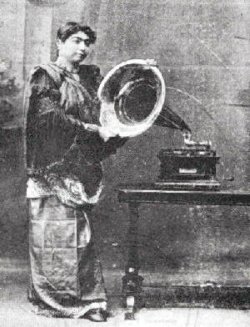
My Name Is Gauhar Jan – these words added spontaneously at the end of a 78 rpm record by one of the most prolific artists of Gramophone Company more than a century ago started a trend in recording, which continued many years after Gauhar’s golden voice faded out. In 1902, Gauhar was requested to record her songs for the first time by the Gramophone Company – she was the reigning diva of Calcutta entertainment industry then. Gramophone Company’s Engineer F W Gainsberg wrote that she was instrumental in ensuring early success for this new medium in India. For every “performance” Gauhar used to charge a princely sum of 3000 rupees! Gainsberg or for that matter, anyone in his place would have been ready to pay that amount for the most popular singer-dancer-entertainer of the era, who could sing in 20 languages and dialects including flawless English. But what astonished Gainsberg more than her singing prowess was her wealth and fashion statement – she always came in a new gown and never even repeated her jewels!
Gauhar Jaan gave her maiden performance at the age of 14 at the court of Maharaja of Darbhanga in 1887 and since then came to dominate Hindustani classical music-dance scene for the next few decades. She was pretty with beautiful eyes and had a rich voice but more than that she was intelligent and could floor any connoisseur with her magnetic charm. Her new compositions along with her new fashion styles and quick repartee used to leave her rich patrons spellbound. She was much more than an ordinary tawaif – her rendition of thumris and dadras were copied by budding classical singers, including a young Begum Akhtar. She belonged to that era of transition, where thanks to large-scale concerts at the houses of some of the rich patrons and then with Gramophone records, she could enthrall even ordinary music aficionados. And thus the legend of Gauhar Jaan was born. Even almost a century later, Gauhar still captivates us as the last diva of the pre-silver screen era. A recent book by Vikram Sampat – which very thoughtfully comes with a CD of her songs – captures the mystique of Gauhaar Jaan effectively. I recently also happened to watch a (highly forgettable) Bengali play on her life – Jaan-e-Kolkatta.
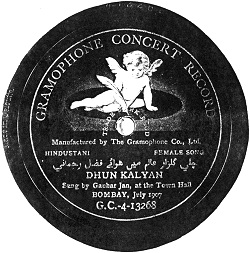
Gramophone Company 'Concert' 78 label - Gauhar Jan singing 'Dhun Kalyan' at the Town Hall, Bombay
Angelina Yoward, an Armenian Jew, was born on 26th June 1873 at Ajamgarh, UP.  Her father William Robert Yoward was working at a dry ice factory there. Her mother Victoria Hemmings was born and brought up in India and received training in Hindustani Classical music and dance. A few years after Angelina’s birth, Victoria ran away with a minor Muslim noble man. It was then Victoria adopted Islam and changed her name to Malka Jaan and Angelina became Gauhar. Gradually Malka became a famous Kathak dancer and classical singer in Benaras-Lucknow circuit. She came to be known as Badi (eldest) Malka Jaan, as there were at least three other tawaifs of that name then and she was the senior most. With Calcutta – the seat of power and business - emerging as a capital of culture too, Badi Malka shifted base in 1883 and found herself at the court of exiled Nawab of Lucknow, Wajed Ali Shah.
It was in Calcutta, Gauhar received training from the best experts of that time. After her first concert, she soon eclipsed other singers and as her record labels proclaimed, she was the “first dancing girl” of her time. She used to go to various royal courts all over India and gave performance at Town Halls in different cities. In 1911, she performed at the Coronation Darbar in Delhi, where along with Janki Bai of Allahabad, she sang “Muarak ho Mubarak ho, tajposhi ka jalsa”. It is believed that her recording of a Khayal in Raag Jogiya in November 1902 is the first Gramophone recording in India. She recorded in her life time a mind-boggling 600 records in different languages and was chiefly instrumental in popularizing light Hindustani classical. Very few people could actually gain entry to her famous Chitpur Road residence or afford to invite her for a performance. But her mystique was partly built on that – an extraordinary talent not easily accessible to public. It is said that Gauhar used to drive past Calcutta Maidan in her huge phaeton and was once fined Rs 1000 for obstructing the passage of the Viceroy, who apparently charmed by her beauty took his hat off and acknowledged her greetings!
Gauhar, incredibly rich at the height of her fame, lost her wealth and properties due to machinations of her manager turned husband. Gauhar – Court Singer at different points at Darbhanga and Rampur, finally decided to go to Mysore in late 1928 as a Palace Musician after she lost even her Chitpur Road and Free School Street residences. Gauhar died in Mysore on January 20, 1930. Before that in Calcutta, a broken heart Gauhar was forced to teach young stars, where she reportedly sold a bandish for one rupee but could not bring down herself to accept fees from her students directly. One of her students later recounted how she used to leave coins under the pillows. As Bombay eclipsed Calcutta as the centre of entertainment industry in late 1930s, along with many others this student of Gauhar, Jaddan Bai shifted base to Bombay, where she sang and acted in films. Very few people today remember Jaddan Bai, but all of us know her famous daughter Nargis, who was born as Fatima Rashid in Calcutta in 1929.

Sunday, March 6, 2011

Ancient Analog

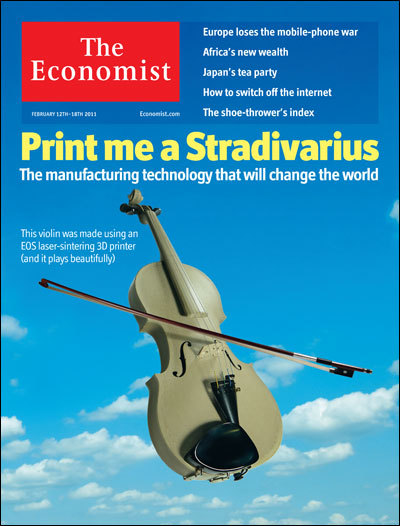
One of my few complaints against my favourite magazine The Economist is that they do not normally give much space to non-political, non-economic topics even though their treatment of such topics is always very interesting and thought provoking. So I was pleasantly surprised when the cover story in a recent issue was on a new technology – Print me a Stradivarius: The manufacturing technology that will change the world (The Economist, February 12th -18th 2011). It talks about a revolutionary new  

  technology called additive manufacturing. This technology uses 3D printers to produce real life objects (as per your design) by putting layers after layers of the basic material (hence the name additive). The cover carries picture of a violin made using a 3D printer, which the magazine certifies, plays beautifully. From a simple coffee mug to aircraft parts you can literally create a world of your own with the help of this technology. Economist predicts that if the Industrial era was about mass production then this technology of new generation cottage industry is likely to disrupt the entire socio-economic foundations of the present global economy. There is a long list of possible disruptions from assembly line manufacturing and competitiveness of Asian manufacturers to urban life and intellectual property regime – but one has to agree with the magazine’s conclusion that in the long run it is bound to expand not only the realm of industry but also of human imagination.
How far you can expand your imagination while thinking about technologies in the ancient world? No, I am not talking about whether Pushpak raths were actually aero planes or such stuff. As far as our knowledge goes (and honestly that is not very far) the most amazing machine manufactured in the ancient world (of which we have definite material evidence) was almost like an analog computer (albeit for only a given subject).
See Explanation.  Clicking on the picture will download
 the highest resolution version available.
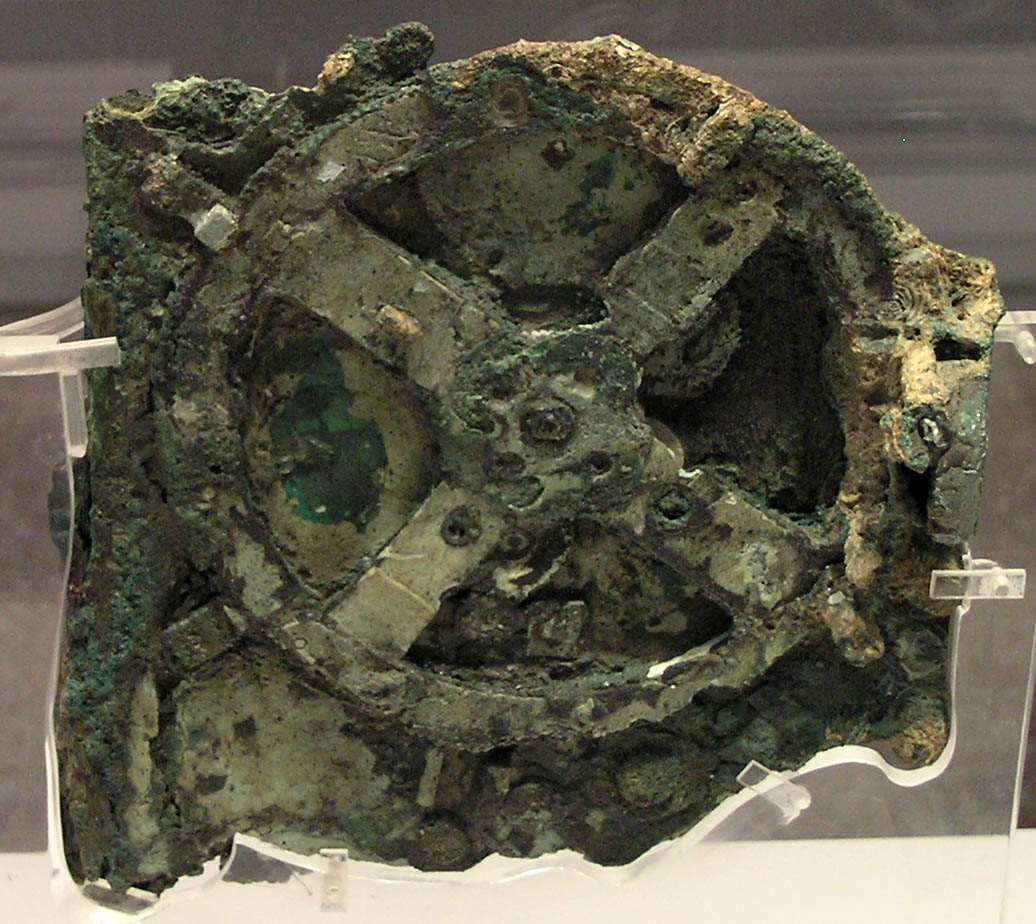
First time when I heard about it I could not really expand my imagination to accept that such a thing was in fact manufactured in the second century before Christ. In 1900-01, sponge divers off Point Glyphadia on the Greek Island of Antikythera recovered certain articles from a shipwreck site. The ill-fated ship went under water sometime in the 1st or 2nd century BC. Among the recovered articles was a mechanical

 device since known   Antikythera mechanism. It took experts actually decades to fully understand how it worked – perhaps because they could not really expand their horizon of imagination and also because certain parts of the machine were lost. Now the device is displayed at National Archaeological Museum at Athens along with a full size reconstruction. Replicas of this amazing device could also be seen in a number of other prominent museums around the world, including at Computer History Museum at Mountain View, Calif. not far from the headquarters of Google.
The device is actually a multi-geared programmeable machine, which could predict exact astronomical positions at a given time. In terms of sheer mechanical complexity, the world did not see anything like it till at least 14th century, when mechanical clocks were manufactured for the first time in Europe. The device had over 30 gears (according to one researcher it actually had 72 gears!) and three dials- one in front and two at back. After a date was entered via a hand crank, the device used to give exact position of Sun, Moon and other planets including Mars and Venus on that date. Front dial had three hands to show the date and positions of Sun and Moon. Front dial also contained marks of the ancient Egyptian calendar (Sothic Year) and Greek Zodiac signs. Another outstanding feature of the device was that in all these there were adjusting mechanisms for Leap Year (in Sothic Calendar, till the invention of Julian calendar in 1st century AD no calendar had provision to adjust extra 0.24 days per year) and anomalies in orbits of Sun and Moon. It has now been proved that the actual calculation behind the machine was based on Babylonian astronomy and not on Greek astronomy. But the complexity of the device simply goes on to show the incredible depth of knowledge the creators had in mathematics and astronomy besides their amazing skills in mechanical engineering. The front dial also contains a parapegma, precursor to modern almanac. Two back dials show divisions of  Metonic and Saros Cycles respectively – all these were somehow very important in prediction of exact date, timing and planetary positions. It is of course quite difficult for a non-specialist to understand but not so difficult to appreciate the enormous knowledge behind this rather small device. The full size model made by Derek de Solla Price shows how wonderfully it worked.


 Reconstructed model of Antikythera mechanism by Derek de Solla Price
The fact that it was so brilliantly designed and then sort of miniaturized indicates that there was a tradition of such mechanical activity before this particular device was manufactured. Two important questions come to mind – who built this and how the tradition was lost? For the first, there are some speculative answers – one of the latest researchers says it was some way connected with the great scientist Archimedes. Others talk about an academy founded by Posidonius in the island of Rhodes, which was known for its expertise in astronomy and mechanical engineering in ancient Greece. I could not find any answer anywhere in the internet about the second question. There were suggestions that some of the skills behind this device might have survived in Byzantium and then in the Islamic world- but that is hardly a satisfactory explanation. It must be considered a matter of great regret that such advancement in technological knowledge achieved in the second century BC could not be sustained by mankind.
  Antikythera Mechanism continues to amaze and puzzle us more than 100 years after it was rediscovered.Now there is a full-fledged project dedicated to this extra-ordinary machine-the Antikythera Reaserch Project is fittingly being carried out by a number of Greek Universities , University of Cardiff and computer giant Hewlett -Packard. 

Wednesday, January 19, 2011

Medicine Men of Ancient India

 One day one of my friends – a truly argumentative North Indian – went on fighting with me on Bengal caste system, more specifically about the Baidya caste. I felt the main problem in bridging our respective understanding of non-Brahmin literary castes (like Kayasth) was the absence of a specialized caste for doctors in North India. Perhaps – my knowledge of Indian caste system is limited – there is no equivalent of Baidyas in the rest of India. Outside Bengal, it was mainly the Brahmins, who practiced Ayurveda. On another occasion, recently my wife (another North Indian) was really surprised to know that my gotra is Dhanvantari. Again I do not know whether most Baidyas in Bengal have this particular gotra but any one remotely interested in Indian myths would recall Dhanvantari was the person, who received the knowledge of medicine from Brahma and was deified as the God of medicine.
Ayurveda – literally the knowledge of long life was known to Indians from around the second millennium BC. For the first time we find mention of a separate branch of knowledge to deal with medicine in the Atharvaveda, which was compiled sometime between 1500 and 1000 BC. It is believed that the great text of Sushruta Samhita was written sometime around 700-800 BC and the great surgeon performed his miraculous surgeries before 800 BC! The earliest dated manuscript – Bower Manuscript is however from the third or fourth century AD. We have a tendency to gush over hoary heritage but even a cursory look at the Sushruta Samhita would confirm the tremendous progress made by ancient Indians in medicine. The book was organized in 184 chapters and gave details of more than 1100 diseases. Details given about human anatomy confirms that there was no taboo on dissection. The book contains details of more than 700 medicinal plants but more than that it provides details of mineral and animal preparations – in the 16th century, the
great pioneer Paracelsus (after his extensive tour of Asia) became the first doctor in Europe to use minerals in medicine.

Sushruta, more than anything else is known as the father of surgery – I find it simply mindboggling that he knew about most of the regular surgical methods used by allopathic doctors till around 1950. These include all types of fracture management, caesarian section, plastic surgery and hold your breath, cataract surgery.  He used a special curved needle – called Jabamukhi shalaka to push cataract out and then used to soak the operated eye in warm butter! A British surgeon Joseph Constantine Carpue spent 20 years in India at the beginning of the 19th century to learn plastic surgery methods described by Sushruta. Among the methods he leant was a procedure called rhinoplasty - how to use a flap of skin taken from forehead (or other part) to reconstruct a nose. In the western world, Carpue performed this surgery for the first time in 1815 – since then it is known as Carpue’s operation. Rhinopasty across the world is still done in the same method as described in Sushruta Samhita. This is just about Sushruta Samhita, equally if not more impressive is Charaka Samhita (written during the Maurya period) and various other texts.
At least for 3500 years, Vaidyas have served the society across the sub-continent. They tried to find locally available cure for every deadly disease and tried to treat every individual patient differently – something allopathy is trying to do now at much higher level through gene profiling and tracking family medical history. Arab conquest of Sind (712 AD) facilitated transfer of Indian knowledge to the Middle East. Both the physicians at the court of Khalifa Harun Al Rashid in Bagdad were Hindu doctors from Sindh. Sushruta and Charaka Samhita were translated into Arabic by 8th century AD, travelled to Spain and Sicily – two entrepots of knowledge for Christian Europe – and put to practice by Italian doctors.
In the last two hundred years, allopathic medicine has progressively reduced the role of Ayurvedic doctors. Till my great grandfather, all the men in my family practiced Ayurveda. None of his sons or grandsons showed any interest in his vocation. My great grandfather used to practice in Murshidabad and Barddhaman. I used to be a regular visitor to a house at Sealdah in central Calcutta, where my friend’s great grandfather used to earn his living as an Ayurvedic doctor. None in his family also showed any interest to preserve his knowledge.
But the greatest contribution of generations of Ayurvedic doctors has been to instill a sense of well being in our daily routine and in our kitchen. When we eat or avoid a particular substance at a given season or time, we silently pay respect to all those progeny of Dev Dhanvantari, even if we never visit any Vishagacharya any more or disagree on the origin of Baidya sub-caste.

PS: Well, I must admit I know nothing about Ayurveda, my purpose was to tell an interesting story about this great tradition. I am really happy that so many of you felt interested about the subject. Ayurveda Unravelled by Sharadini Dahanukar and Urmila Thatte (National Book Trust) is a good book to begin with. For my Bengali friends, there is a whole series called Chironjib Banausodhi by Kabiraj Shibkali Bhattacharya (Ananda Publishers) - I have just flipped through some of the volumes, it is rich in information but to what extent tested in a modern lab I have no idea. There are also a number of books now in English mainly from Kerala on pharmaceutical side of Ayurveda.
Central Council for Ayurveda and Siddha is the official research body for sarkari research effort in India, even though their output seems quite limited so far  http://www.ccras.nic.in/
Important texts are supposed to be preserved in National Instt of Medical Heritage in Hyderabad- http://iihm.ap.nic.in/
another decent site (at least looks to me) - http://www.ancientayurved.co.in/
In recent years people have become more interested in Ayurveda - but unfortunately more emphasis has been on the wellness side (Ayurvedic spa etc) of it. In comparison, Chinese traditional medicine has received far more serious research interest. The World Health Organization (WHO) accredits Ayurveda as a medical science, even adapting its definition of health as “a state of complete physical, mental and social well-being" - therefore it would be in the interest of the entire mankind if doctors/pharmacists/researchers take it up more seriously.

Thursday, December 23, 2010

Jewel Box of Agra

These were not painted on paper or cloth….these intricate patterns were not designed in computer – all these were crafted in stone some 400 years back. Welcome to the stunning jewel box of Agra, welcome to Itimad-ud-daula, which you ignored last time you went to the erstwhile Mughal capital. Completed approximately three decades before the greatest monument of love, the tomb of Itimad-ud-daula is a breath- taking tribute to the first family of Mughal servants. And it was erected by the most famous lady in the history of Mughal dynasty – Nur Jahan. It stands as a testimony to the family’s standing and also as a turning point in the evolution of Mughal architecture, which culminates at Taj, hardly a few miles away on the other bank of the river Yamuna. Hidden behind these incredibly beautiful designs are unseen forces of this subcontinent’s history and an unparallel story of love and intrigue.
The story starts with an Iranian nobleman Khwaja Ghiyas Beg, who came to India on a fortune hunt. Ghiyas Beg’s father was a prime minister at Khorasan but cruel turn of fate forced him to abandon his homeland and flee towards the Mughal court in search of employment. His daughter Mehrunissa was born at a particularly difficult period during the arduous journey near Kandahar (1577). Her parents – under dire clutches of circumstance – were forced to abandon the baby. A caravan of merchants coming behind them picked up the girl child and handed over to the distraught couple a few days later. It was the leader of that caravan, who took Ghiyas Beg under his care and introduced him at the court of Akbar. By dint of his sheer hard work and talent Khwaja Ghiyas Beg and then his son Asaf Khan rose very fast through the rank of Imperial hierarchy. In 1605, Ghiyas beg was given the title of Itimad-ud-daula (Pillar of the State) and promoted to the post of diwan by Jahangir. Meanwhile, at the age of 17, Mehrunissa was married to a middling Iranian noble Ali Quli Istajlu, Sher Afghan (reportedly the match was arranged by Akbar himself). Everyone at the darbar was much impressed with the sophistication and taste of this highly educated Iranian family but the real turn in family’s fortune came through this daughter.

In 1611, Emperor Jahangir fell in love with     Meherunissa – then a widow of around 35 – and immediately married her (Meherunissa became Jahangir’s 20th wife). Soon her father (who was recently caught in a bribery scam and also arrested for alleged links with Khusru) was made the Diwan and brother Asaf Khan was made Mir Bakshi (Imperial Pay master); Nur Jahan’s extended family also held the governorship in 7 out of 12 provinces– this concentration of power in the hands of a single family was not only unprecedented but also would not be replicated till the dying days of the Empire. Meherunissa accompanied Emperor Jahangir everywhere and was equally adept in horse riding and big game hunting apart from her highly sophisticated taste in culture. Jahangir (whose formal name was Nur-uddin) renamed her Nur Mahal (Light of the Palace) and then Nur Jahan (Light of the Universe) – the name in which she was to become famous for posterity.

Nur Jahan’s daughter from her first marriage Ladli Begum was married to Jahangir’s son (from a concubine) Shahryar. Asaf Khan’s daughter Arjumand Bano Begum (future Mumtaj Mahal) was married to the most powerful of Jahangir’s sons, Prince Khurram. It has been alleged that this Nur Jahan Junta (Itimad-ud-daula, Asaf Khan, Khurram along with Nur Jahan) actually used to run the empire even as Jahangir went on increasing his daily intake of opium. Symbolically, the apogee came when Nur Jahan was portrayed alongside Jahangir in imperial gold coin (only instance during the entire Mughal history), implying that she was no longer a mere consort but a co-ruler.
Nur Jahan started building the tomb of her father in 1622 at the height of her power and it was completed in 1628, shortly after Jahangir’s death and Nur Jahan’s fall from power. It represents a great transition in Mughal architecture from its first to second phase. From pre-Akbar days, Mughal buildings - both public and military buildings (like mosque or fort) and funerary buildings (more personal) were built in red sandstone. From the days of Humayun’s tomb (built by Humayun’s sister Gulbadan Begum), Mughal artisans specialized in marble inlay within sandstone panel. But it was at itimad-ud-daula, we see for the first time a complete mausoleum made of marble. Itimad-ud-daula is also significant for two more architectural trends, seen for the first time in Mughal buildings – pietra dura or large scale stone inlay using precious and semi-precious stones and chiaroscuro or the use of light and shadow technique.

           The tomb, which actually houses not only the mortal remains of Itimad-ud-daula but also his wife Asmat Begum and some of the other members of Nur Jahan’s family, including her daughter Ladli begum (also named Meherunissa). Situated on a rectangular plot right on the banks of the river, the complex has four huge gates, built of red sand stone but decorated with marble inlays much like Humayun’s tomb or Sikandra. Inside, the rectangular marble mausoleum is set amidst lush green Mughal cheher bagh. It is a single story structure with four minarets. But the base of the monument is still in sand stone. Perhaps it was kept lower deliberately – they were Royal servants but not the Imperial family. Someone like Nur Jahan would have been acutely aware of this difference in status.

Even though at times it is called the baby Taj but what it lacks most is the symmetry of Taj. Over the structure’s flat roof rises a beautiful cupola, topped with foliated lotus like design. Inside the main hall lie the sarcophaguses of Nur Jahan’s parents in asymmetrical fashion. In rooms around the main hall other mazars are scattered (Nur Jahan herself is buried in a simple mausoleum at Shahdara Bagh in Lahore, next to Jahangir’s final resting place). The entire structure sits like a jewel box. Every side of the structure has three arched doorways with the middle one being the actual door. But the most impressive and elegant craftsmanship is to be seen on the panels and floors of the mausoleum.
Pietra dura – which originated in the Roman Empire and flourished in Italian cities like Florence in the 16th century, has sometimes been described as pittura per l’eternita or painting for eternity. It surely describes the panels and floors of Itimad-ud-daula best.  But the central Asian or Iranian stone inlay work was somewhat different from the European tradition as could be seen from the stunning Lotfallah mosque or other buildings at Nasq-e-Jahan square  at new Safavid capital Isfahan(built in late 16th century). Surely the craftsmen for Itimad-ud-daula came from outside India. The family’s Persian connection was perhaps directly responsible for that. Mughals began like titans and finished like jewelers – this is an oft-quoted statement, but the finish would not have come without the infusion of this Persian sophistication.

The other design trait or using extensive stone jali (screen) also started with this tomb. Inside the mausoleum, as the sunlight seeps in intricate pattern through this beautifully carved screens and falls on tiles of geometric design, it creates a serenely different world altogether. Both the craft heritage of pietra dura and chiaroscuro would be carried much further in Taj and royal buildings inside Lal Quilla and Agra Fort during Shah Jahan (Prince Khurram)’s time. His master builders had more confidence in using marble for the entire building, even at the base. But the sheer elegance of this first experiment provides the most beautiful interlude in the annals of Mughal architecture.
 
Eventually Khurram and Nur Jahan fell over and Khurram rebelled against his own father. Even though the rebellion was controlled, Jahangir died in 1627 and Khurram – with the help of his father-in-law and Nur Jahan’s brother Asaf Khan – easily triumphed over Nur Jahan’s choice Shahryar (her son-in-law). But the former partners reached an agreement. Nur Jahan withdrew from public life, dedicated herself to building the mausoleum at Lahore and to the art of perfumery, which she learned from her mother (according to Indian tradition, it was her mother, who invented rose ittar). Even amidst the clutter and congestion of today’s Agra once you are inside Itimad-ud-daula complex, the fragrance of her taste wafts through the morning mist set over the dying river.

Wednesday, December 8, 2010

Freddie n' Rohit


1st December is World’s AIDS day and a release by UNAIDS on this occasion strangely brought to my mind images of two odd-ball icons of our teenage years. New cases of HIV infections have come down by 50% in India between in last one decade (2000-2009) – this is very much in line with other HIV/AIDS hotspots around the world, like most parts of Africa. This is mainly due to increased awareness about this deadly disease. First documented death from HIV/AIDS was that of Robert R – an Afro-American teenager, whose death in 1969 baffled doctors as AIDS was not ‘discovered’ until 1981. But the first time American public came to know about the disease is actually when Rock Hudson became the first celebrity to openly acknowledge it shortly before his death in 1985. Death or infection of a few more celebrities made Americans more conscious about various methods, through which this disease can spread. For instance it was the shocking announcement that their famous basketball star Magic Johnson has been diagnosed with HIV made a whole lot of people aware that HIV may be contracted due to multiple heterosexual partners also (up until then it was thought to be spread only through homosexuals). At the same time Magic Johnson’s heroic battle against HIV/AIDS helped spread the message that HIV could be successfully combated.
In India of early 1990s, AIDS was still a taboo subject to be mentioned in general newspapers or magazines let alone in family dinner table. Infections and subsequent death of two very odd-ball Indian celebrities from AIDS forced the mainstream media to at least mention it. I keep on saying odd-ball because we do not have much right to claim Freddie Mercury (1946-1991) - as an Indian celebrity and I doubt, how many Indians have actually heard of the other celebrity victim - Rohit Khosla (1958-1994). First time I learned that AIDS is a deadly disease and there is no cure for it is when I read that Freddie Mercury’s death (he acknowledged it only a day before his death that he had AIDS). I am never a regular music buff and my knowledge of all genres of music is very limited. But as a Bengali in Calcutta one is bound to be surrounded by all types of music aficionados and it is this passive listening which made me aware of Freddie Mercury’s existence as one of the leading rock stars of that time (he continues to be rated as one of the greatest singers ever even 20 years after his death).
      
Freddie Mercury was born Farokh Balsara in Zanzibar in a Parsi family from Balsar(Valsad), Gujarat. He spent his early years in Panchgani, where he studied in a boarding school and Bombay. When his family shifted to England, young Farokh at the age of 17, also joined them. For the rest of his life he remained a British citizen. A singer and musician since his school days, Farokh – who liked to be known as Freddie – became famous when he formed the band Queen with Brian May and Roger Taylor in 1970. It was then he changed his name from Freddie Balsara to Freddie Mercury. As the song writer and lead vocalist for Queen, Freddie became world famous. I did not know about his flamboyant stage performance then but what we all knew were his super hit songs like Bohemian Rhapsody, Little Thing Called Love and We Are The Champions. Later on I learned that Freddie Mercury was bisexual – don’t remember that being mentioned in newspapers and magazines I used to read. I also learned that not only for me or my friends, in the global history of AIDS awareness Freddie Mercury’s death was an important event as he was the first rock star to have died of AIDS.
               Today’s generation will laugh at us but as teenagers we were greatly excited when a second channel of Doordarshan – DD2 or DD Metro was launched in late 1980s. There used to be a programme on fashion once a week around 7.30 PM in DD Metro– unfortunately I have forgotten the name of the programme - which much like Pop Time (Sunday evening) opened our window to high fashion. A number of fond memories are associated with this programme, not the least of which was seeing Aishwarya Rai as a ramp model in her initial days. It was in this programme I came across Rohit Khosla for the first time.
Rohit Khosla was India’s first fashion designer in the modern sense. He launched India’s first modern fashion store Ensemble (1987) along with Tarun Tahiliani and a few others and they were the first to launch their own names as a brand. Before them there were costume designers or anonymous shop-owner-tailor designers but haute couture had to wait till Rohit Khosla came back to India from the UK in mid-1980s. I hardly know anything about Rohit Khosla’s personal life apart from the fact that he studied at Doon School and went abroad for further study and a possible career there. As he told an interviewer in that programme, when he launched his fashion label the most frequent reaction from people used to be, ‘see this guy, he went to Doon School and abroad only to become a tailor!!’ Today as I search internet there is hardly any information on the life on India’s first fashion designer – there is a book by his sister, ‘Rohit Khosla, Vanguard’ – but the book is apparently not very easy to find. Not only he was a pioneer in terms of launching his own label, he also nurtured at least two generations of Indian fashion designers – Ensemble launched Tarun and Sal Tahiliani, Amaya, Abu Jani and Sandeep Khosla. First batch of NIFT graduates also trained under him and the list includes, among others J J Valaya, Ranna Gill, Sonam Dobal, Aparna Chandra. As I said I don’t know anything about his personal life but I was stunned to know that he was dying of AIDS. There was hardly any detail or discussion about it. Rohit Khosla passed away in 1994.
     Today a lot more people know about the disease and that has brought down the rate of infection – surely it is healthy sign and a tribute to NACO. But I cannot help thinking that had our media and society been open enough discussing these unfortunate deaths then Indians would have come to know the reality faster – much like what happened to Americans following the demise of legendary stars like Hudson or Arthur Ash or detection of Magic Johnson.
In 2007, India Fashion Week paid a tribute to Rohit Khosla. One of Rohit’s favourite models, Nafisa Ali – who famously modeled for his posthumous collection with a shaven head – today runs a home for HIV/AIDS affected people and she, according to her own admission, was moved by the memory of Rohit. Remaining members of Queen founded a trust in Freddie Mercury’s memory – Mercury Phoenix Trust - which has raised millions of dollars for AIDS charity.


Friday, December 3, 2010

Memories Metaphor and Modern India

Nearly three decades (Published 1983) after its first publications, Sumit Sarkar’s Modern India remains the best summary of the most tumultuous period of Indian History (1885-1947).  Formal students of History have spent countless hours guided by this masterful survey of Indian nation and nationalism; non-History students preparing for Civil Service or other exams, on the other hand, grumbled about this “difficult” book. But both the parties did not have any other option. Well, there are options – and one of the most recent of them, Sekhar Bandopadhyay is quite good – but then, if you want to understand the complexities of Modern India (today it seems more like Emergence of Modern India) Sumit Sarkar is irreplaceable.
Sumit Sarkar was born in an illustrious Brahmo family of Calcutta in 1939. His father Susobhan Sarkar was a legendary Professor of History at Presidency College. Prof Sarkar was also one of the leading lights of Santiniketan under Rabindranath and played an important part in spread of communist thoughts. Sumit’s maternal uncle was P C Mahalanobis. Sumit Sarkar’s sister Sipra has been a renowned Professor of History at Jadavpur University.  He studied at St Xavier School, Presidency College and Calcutta University. His doctoral thesis on Swadeshi Bengal was his first major research work. He taught at Calcutta and Burdwan University before moving to Delhi University in 1976. His wife Tanika (daughter of another famous Presidency Professor Amal Bhattacharya of English Department and Sanskrit scholar Sukumari Bhattacharya) is also a well known historian – in fact Modern India is dedicated to Tanika. Marxist thoughts had a deep impact on Sumit Sarkar and he was one of the founders of subaltern studies, who later mourned the decline of subaltern in subaltern studies. He has written extensively on politics, society and historiography of modern India. But his most famous work has been Modern India.
I have spent many a lazy afternoon and warm midnight with Modern India. I am – like million others – sort of addicted to it. Once in a while, I like to open the book and read about a particular movement or a particular incident – almost every time I realize the value of a particular information or analysis all over again. I do not think it is an easy book for any student. He writes very long sentences with hyphen, comma and semicolon holding multiple pieces of information together. His analysis presupposes a certain degree of familiarity with historiography of modern India and at times with British or World History. Yet the more you read more you get drawn into it. Long after your examinations are over and you try to teach or talk or write about any particular phase, you realize you are unknowingly following Sumit Sarkar’s scheme of presentation. I suppose that is what happens with most of the college and university teachers across the country.
From the point of view of a professional historian there may be a number of problems with the book. Today, in certain aspects, it has become dated as well. Perhaps the most important of all, the inelastic boundary of Modern India – 1885-1947 – today appears unacceptable. I have always wondered why Sumit Sarkar never thought of writing a second volume of his Magnum Opus. But today my growing unease about “Modern India” is not so much on account of its time period but for its near complete focus on the Political part of Modern India. Agreed, that Sumit Sarkar made a significant departure from personality-centred history of high politics, yet, the main focus is on how political consciousness spread to different geographies and social layers, ultimately culminating in partition and independence.
Once upon a time, economic history of India was a craze among the brightest of research scholars. Unfortunately not only it has lost its glamour for researchers, graduation student is also still stuck at old notions of one dimensional Drain of Wealth or how commercialization of agriculture impoverished Indian peasantry. Recent researches (of last three decades at least) into regional variation of agrarian economy, small-scale industry and entrepreneurship have gone totally unnoticed. As a result, the obvious linkages between economic development and political movement – particularly at regional level – are not visible. A good point to start here could be Tirthankar Roy’s Economic History of India.
In last two decades or so, Social and Cultural history has, on the other hand, generated a tremendous interest among scholars, journalists and performers. Some of the greatest themes of Indian history during this time period – emancipation of women, emergence of middle class, caste mobility, mass entertainment - definitely fall into the realm of socio-cultural history. I have seen interesting books/ write-ups on various aspects of socio-cultural history but cannot think of a single volume survey or general introduction. The volume edited by Prof Dilip Menon may be taken as an interesting introduction to socio-cultural stirrings of this period but it is not comprehensive in its scope.
How long is it going to take for a new Modern India to be written with equal emphasis on political, economic and socio-cultural developments? That cannot totally replace Sumit Sarkar but will definitely produce a more comprehensive picture of how modern India took shape and will be far more interesting to general students. Again teachers in India stubbornly refuse to make History teaching a more multidimensional experience. Why can’t we prescribe a few novels and autobiographies as part of our modern India syllabus? Movies and digital photo archives can provide another wonderful medium to connect History with today’s generation.
I like to read whatever I can lay my hands on - novels, autobiographies or watch movies or exhibitions – but finally it is Modern India, which helps me to link my new piece of information with the grand narrative. These days often I feel social mobility or cultural movements are inadequately covered but still the voice of gentle Professor remains my best guide. It never occurred to me that I have not been his direct student.

Tuesday, November 23, 2010

The First Cut

 
                 A few days back Sri BM Kankanwadi Ayurvedic College in Belgaum was suddenly in the eye of a global media storm. In this little known college, 40-year-old Dr Mahantesh Ramannavar gave his students an extraordinary lesson in anatomy, by dissecting his father’s dead body. His father BS Ramannavar passed away at the age of 89. Senior Ramannavar donated his body to science but he also stipulated that if a dissection was to be performed, it should be carried out by his son. On November 13, 2010 – exactly two years after his father’s death, Mahantesh performed the dissection. Alongside his students, his family members and others watched the spectacle from a distance and it was broadcast live on many channels. Soon – as it happens these days - the video went viral on YouTube and everyone had something to say about this extraordinary event.
                          Reading about this news event, I thought about the most important dissection in the history of modern India. On the morning of 10th January, 1836 fifty gun salute was fired from the ramparts of Fort Williams as Madhusudan Gupta entered the dissection room of Calcutta Medical College. What happened next is best described by a contemporary account “…at the appointed hour, scalpel in hand, he followed Dr Goodeve in the Godown where the body lay ready. The other students deeply interested in what was going forward but strangely agitated with mingled feelings of curiosity and alarm crowded after them but durst not enter the building where this fearful deed was to be perpetuated; they clustered around the door, peeped through the jilmils, resolved at least to have ocular proof of its accomplishment. When Modusuden’s knife, held with a strong and steady hand, made a long and deep incision in the breast, the lookers-on drew a long-gasping breath, like men relieved from the weight of some intolerable suspense” (John Drinkwater Bethune, pioneering educationist, started first girls school – today Bethune School and Bethune College). The heavy weight of many centuries was lifted with this single incision and as a later day scholar tried to freeze the moment in history – it was that precise moment in time when western knowledge of medicine symbolically entered Indian body.
                  Calcutta Medical College - India’s first medical college - started medical teaching on 1 June, 1835 with 49 students but very soon a practical problem cropped up. It was unthinkable for high caste Hindu students to defile a dead body. Not only for the students even for the society it was unacceptable. But without basic knowledge of anatomy further progress was hampered. Today going by the evidence of advancement in surgery in Ancient India, it can be said without any doubt that they were familiar with cadaver dissection. But for centuries Ayurvedic students did not practice human dissection. Both the authorities and concerned local elites worked together to find a solution to the problem. It finally fell upon Madhusudan Gupta, the Chief Native Teacher of the school to break the taboo and at the same time to provide religious sanction for such an act. Even as the government hailed his heroic act, his own society promptly ostracized him. Later in an open debate – organized by some British educationists with government support – he quoted Sanskrit texts to persuade conservative Brahmins of Calcutta to accept cadaver dissection. His shastric knowledge finally helped him to end his social boycott and more importantly, paved the way for his students to acquire modern medical knowledge.

Madhusudan Gupta (1800?- 1856) was a remarkable person. He was born in a well established family of Ayurvedic doctors (Vaidyas) in a place called Baidyabati (residence of Baidyas i.e. Vaidyas), some 50 kilometres from Calcutta. We have no information about his early life but apparently he did not show much interest in studies. In 1826, he joined the newly started course on Ayurvedic medicine in Calcutta’s Sanskrit College (Company government started two courses for native medical students – Ayurvedic course at Sanskrit College and Unani course at Calcutta Madrasa). In 1830, for his exceptional talent Madhusudan was made a student-cum- teacher in the same college. After finishing his formal education at the college, he was appointed as a full-fledged teacher. When Calcutta Medical College was established in 1835, he was appointed the Chief Native Teacher there. His primary responsibility was to translate and guide first generation of Indian medical students. While being a teacher, he was persuaded to appear for MBBS exam, which he cleared with distinction in 1840. Very few people could actually pass MBBS in first few years. As the government needed many more Indian doctors – particularly for the Army – they started a shorter course for Indians through Hindustani and Madhusudan was made the Superintendent of that course. Later in 1852, a course in Bengali was introduced and again it was Dr Madhusudan Gupta, who was asked to be the head. Already in 1849, he was made a First Class Sub-Assistant Surgeon. He also translated a number of English text books into Sanskrit and Bengali and in that process coined some of the first medical terms in Bengali.
We know almost nothing about his personal life or how he felt as a professional. In a deposition before a government appointed committee on the condition of medical facilities in Calcutta in 1837, we catch a glimpse of this extraordinary doctor: he outlined the need for compulsory vaccination of children for small pox and pointed it out that in the previous 20 years how the number of such cases have come down due to the effort of native vaccinators. Even more remarkably he insisted on providing midwifery training to Hindu women, so that they can save precious lives. He said that the main problems of native quarters of Calcutta were unhealthy living conditions – narrow streets, contaminated drinking water taken from public ponds, lack of ventilation, garbage lying on the street and rotting fish and vegetables in open markets. He mentioned Barabazar, Mechua, Kolutola as some of the most unhealthy localities of the city. 180 years after his observations, Calcutta continues to be the same unhealthy city of narrow roads with garbage lying on the street and Barabazar and Mechua continue to be the unhealthiest parts of the city! That is perhaps the biggest disservice to this pioneer of public health.
On 15th November 1856, Madhusudan , a diabetic patient died of diabetic gangerene of hand, an infection contracted during a dissection.  On his death, the Director of Public Instruction wrote, “…to him a debt of gratitude is due by his countrymen. He cleared a jungle of prejudice, into which others have successfully pressed.” Pandit, Kaviraj, Doctor Madhusudan Gupta was an example of extraordinary moral courage against prejudice of centuries.