Pages

Saturday, May 28, 2011

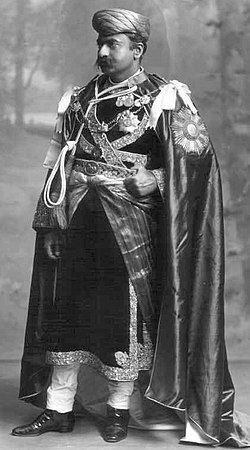
Renaissance King of Gondal

When we hear of an Indian Prince of 19th-20th century, the first image, which comes to our mind, is that of limitless luxury and self-indulgence. Could you imagine an Indian ruler in late 19th century, who studied medicine abroad, became a Fellow of Royal Society, made women’s education free and compulsory in 1880s and abolished taxes in his territory?

During our recent trip to Gujarat, our friend, who was making all the arrangements, casually asked us "would you like to stop for a while at a place near Rajkot? They have a nice collection of vintage cars". That was the first time I heard the name of a place called Gondal. Even as we were entering the town past a non-descript railway crossing, we were still skeptical. Mostly it looked like a typical Indian district town except for an old but beautifully designed school building on our way to the vintage car collection.

I am not a vintage car enthusiast so I did not actually know that the Gondal Collection is world famous. Royal Garages of Gondal is located at the Huzoor Palace, which is also known as the Orchard Palace as it is surrounded by huge gardens and fruit orchards. This palace is the current residence of the royal family even though a wing of the Palace has been converted into a heritage hotel. I could see a vintage car-cum-coach from 1903, which could be attached to any type of engine, then there were spectacular collection of old Daimlers, Cadillac and Studebakers…..they were real hot wheels. And you could see that they used to start really young as there were miniature models of some of these cars! Not only vintage cars, Gondal family still takes active interest in new models of cars and car racing.
After the Royal Garage, we were given a tour of the Heritage Hotel inside the same property, including a railway coach from the Royal Gondal Railway Service. The Coach has also been transformed into a cute hotel suite! We were already quite impressed, so when we were told by the attendant that we could go and see the Private Museum housed in another royal palace nearby, we were game for it. There are three royal palaces in Gondal at present. Like Huzoor Palace, Riverside Palace built in the late 19th Century has been converted into a heritage hotel. Naulakha Palace is the oldest of the three and was originally built sometime in the 17th century. Housed in different rooms of this palace is a very interesting private museum maintained by the royal family. It was here that I first heard the name of Gondal's greatest ruler Bhagvat Sinh. Different rooms of the Palace brought out different facades of this extraordinary man and ruler. I have heard plenty of stories about opulence and philandering ways (among many other qualities) of Indian princes during the colonial period but I have never come across a renaissance character like Bhagvat Sinhji of tiny Gondal.
Naulakha Palace, Gondal
Gondal came into being as a result of a minor split in the ruling Jadeja family of Rajkot in 1634 and continued as a minor principality till 1947. When his father Sangram Sinh died, Bhagvat Sinh became the ruler (then called Thakore, indicating a status lower than Maharaja) of Gondal at the age of 4 in 1869. He was educated at Rajkumar College in Rajkor even as his state was administered by a British regent. In 1884, he took over the charge himself and soon reformed almost every aspect of its economy and administration. He completely overhauled his administration; introduced town planning, electricity, telegraph, telephone, railway, modern sewage system and plumbing; built dams and irrigation canals. He also improved quality of livestock in Gondal through modern methods. Now as a result of all these, direct income of the state had increased so much that Bhagvat Sinh abolished all taxation in his state!

But more important than that was perhaps his contribution to education - he built schools and colleges in Gondal (the old school building we saw on our way to the Palace was built under his supervision according to the design sent by a British architect) and most amazingly, made education, including women's education FREE and COMPULSORY in 1880s! Throughout his life he remained an ardent champion of women's rights - unthinkable for a man of his age almost anywhere in the world. His daughters used to drive open vehicles in cities and he not only abolished purdah system, but also decided that in new palaces in Goldal, there would not be a separate zenana. There was another aspect of his education policy, which really struck me - he organized training facilities for carpenters, plumbers, painters and such professionals, who are still outside our education system nearly 130 years later.
                                          Interiors of Orchard Palace (Heritage Hotel Wing)
Maharaja Bhagvat Sinhji was equally amazing in terms of his personal achievements. He studied medicine at Edinburg, from where he did his MBBS and MS and later on received FRCP. He was the only Indian ruler till 1947 to become a medical doctor. He also became the only Indian ruler ever to be elected a full Fellow of Royal Society of London (1894). Alongside his administrative responsibilities, he used to treat his patients five days a week working till late night. Always keen to teach people value of hygiene, Maharaja used to inspect cleanliness of Gondal city every night himself. He also participated in International Congress of Hygiene and in such organisations. His LLM degree was honorary but his library was stacked with law books alongside Victorian literature. There were also marble busts of great thinkers in his study. In different rooms, you can watch his magnificent collection of exotica from around the world – models of ships, thousands of miniature cars, shells and other marine products, watches, Murano glass and China porcelain and such stuff. Perhaps he was a bit eccentric but it is astonishing that in one life time one could do so much.
My subsequent search revealed that he wrote a very interesting book on Ayurveda, which was widely quoted in those days in international press (Gondal has at least two ayurvedic medicine factories even today). He also published the first ever dictionary of Gujarati and an encyclopedia Bhagavatgomandal in Gujarati!
And then I discovered it was not only Bhagavat Sinh, there was a very well-known son of Gondal also (only Gondal connection is not known) – Muhammad Ali Jinnah’s family also belonged to one Paneli village in Gondal (his father shifted from Gondal to Karachi for business purposes). There is no end of wonders in this ancient land!!

Wednesday, May 4, 2011

Porbandar: In Search of Mahatma

Inside narrow lanes of old town Porbandar - a small coastal trading post in Gujarat’s Saurashtra coast - lies Kirti Mandir, birthplace of Mahatma Gandhi. It is far easier to pay your tributes to the Father of the Nation at Rajghat - so very few people actually go to this sleepy town, which should have been a national pilgrimage for all of us.
I know someone, who was posted as Police Superintendant of Porbandar a few years back. She was initially thrilled to be posted at a place all of us read routinely in history books. Soon she realized that Mohandas Karamchand Gandhi is something very far off from the reality of Porbandar. The town was then caught in a vicious cycle of gang war and the most dreaded of the criminals was a lady - Sankotben Jadeja. A Hindi movie made around that time – Godmother – was based on her life. It took quite an effort from the police forces over a long period to bring peace in what is still known as Chicago of Gujarat. She was more pained to see on the first 2nd October she spent there that apart from Sarkari functions, there was almost no celebration of Gandhi Jayanti there. Sankotben died only a few days before my trip to Porbandar – a huge number of people, including some political leaders joined her funeral procession – she was also a two term elected representative from Porbandar to Gujarat assembly.
Mohandas was born in this room on 2nd October, 1869 - Swastika marks the exact place! His mother Putlibai was the fourth wife of Karamchand Gandhi – his first three wives died at child birth. His family was quite well off, the three storied house had 22 rooms


Kirti Mandir from outside – this tribute to Gandhi was built with Sardar Patel’s inspiration and money from a local businessman
The museum inside Kirti Mandir is an absolute shame – photographs are just cut from paper - most of them have not been framed; display is pathetic and most of the descriptions printed in typewriter are full of spelling and grammatical mistakes. There is no video or modern presentation either on his life or the significance of the place.
Hardly 100 metres behind Gandhi’s House is Kasturba’s house. Her father was a wealthy trader and childhood friend of Gandhi’s father. They were married when Mohandas was 13 years old and Kasturba 14.
Archaelogical Survey of India – a national shame in any case – did not find Kasturba’s house worthy of protection. It is protected under the act of Gujarat govt. We have named a road in the heart of the capital after Kasturba – is not that enough?
Dawn breaks at Porbandar – right on the sea beach, this magnificent neo-classical palace of Porbandar’s Jethwa rulers today lies absolutely abandoned. Mahatma’s father Karamchand rose to the post of Diwan (Prime Minister) of the Jethwa rulers.
             Silent Witness: Customary Gandhi Statue close to his house at Manek Chowk
Small Town Porbandar – same hanging electric wires, garbage on the street, life stuck at narrow bylanes….we failed to create both a functioning government and a concerned civil society in this country.
Despite Gandhi legacy and quite a beautiful sea beach, Porbandar is not on the tourist map. Mahatma is more of a burden for Porbandar (as much for rest of Gujarat and rest of the country) – there is a new Gandhi Memorial right on the sea beach but locals complain that unnecessarily children’s play ground has been converted into this memorial – who will go to a Gandhi memorial to listen to some seminar – asked an angry resident.
Of course the compound remains locked
And the Gandhi statue carefully wrapped in plastic sheet

As another quiet day ends at Porbander.

Friday, April 29, 2011

Gandhi: Prisoner of Hope

Prisoner of Hope
Father of the Nation needs to carry all our burdens….dreams, aspirations of millions…….do we ever pause to think what the Father wanted from the Nation


De di humme azadi bina kharag bina dhal
Sabarmati ke sant, tume ne kar diya kamaal….


Freedom…..to dream, to squander…..


 Rajat told us – Gandhi’s simplicity was like a child’s play in a chicken field – still don’t know what is a chicken field - but the meaning was more than clear – and it was not only his social philosophy or Congress organization….his message was simple


In New Delhi, I am used to customary portrait of a smiling Mahatma in every public servant’s room – sitting underneath most of us lie habitually, indulge in decadence and behave like feudal lords. We excel in saying no and we are most scared to experiment with truth.


….be open to ideas….let your life be an open book

Tuesday, April 12, 2011

Cherry Blossoms of Life


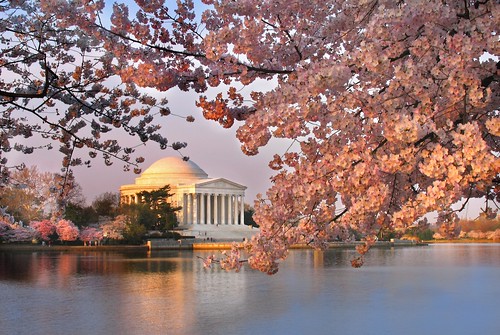
There is something truly magical about walking on the garden path along the Cherry Blossom on a sunlit morning in Washington DC, savouring the beauty of Lincoln and Jefferson Memorial. On one such walk I just suddenly turned back on an impulse – it was a cloudy morning to start with and then Sun came out in a radiant flash – and then I was equally spellbound to see DC from a whole new angle – White House and Washington Memorial standing tall across a whole range of park land. Close to Arlington National Cemetery and home to two of the greatest national monuments – that of Ab Lincoln and Thomas Jefferson – this is something like a national pilgrimage site for every American. Cherry Blossoms are in full bloom there this April for the 99th Year. These trees were gifted by the then Mayor of Tokyo as a mark of friendship.  At that precise moment when I turned back to discover the new vista of the maddening capital of the World’s most powerful state, I realized how Cherry Blossoms provide a true analogy of life for the Japanese.
April is the time for Sakura in Japan – the festival of formally watching Cherry flowers in full bloom. But this year it is quite different – a massive earthquake rocked the Island nation just a month back, followed by a devastating tsunami. More than 25000 people perished in the twin disaster. Not only the scale of devastation stunned the nation but for the first time there was a serious threat of a nuclear meltdown, which alarmed the whole world. As Japan struggles to recover from the shock of it, no one is celebrating Sakura this year. Cherry flowers have been a unique symbol of rejuvenation for the Japanese for hundreds of years.  All of a sudden bare Cherry trees transform into one of the prettiest sights of nature with beautiful Cherry flowers in full bloom. Cherry flowers thus provide a Japanese way of celebrating ephemeral life and its transient beauties.

Japanese Civilization is unique in many ways – even in the midst of Tokyo’s sprawling urban life you will find little islands of tranquility - old gardens with a small waterfall – just like their culture of effortless blending of ultra-modern with the traditional. Even in the face of this great tragedy, there was hardly any display of public emotion. If you have ever been to Japan, I am sure you would not be surprised to read those emails being circulated about public discipline and community efforts. The level of technical perfection (along with discipline) they have reached in their day-to-day life is something amazing. This is for the first time in the wake of a meltdown threat at Fukushima Power Plant that the World has raised questions about Japanese technological prowess. But still Japan remains miles ahead of others in terms of technological progress. Perhaps the best example of it for a tourist is the railway network in Greater Tokyo, which displays train arrival and departure timings in terms of Hour:Minute:Second! Last October in Tokyo, I asked quite a few people whether they remember a train cancellation or running late in the recent past – all of them were more than surprised and did not have any answer for such a silly question. What is also equally amazing is their courtesy and extra-ordinary politeness – something they extend to every human being regardless of social or economic status and even to a complete stranger reaching across language divides.
Japanese economy remains in a state of deflation for more than two decades now – one of the prime reasons for that is lack of innovations in a country, which is the birthplace of most of today’s industrial giants. Why Japan remains stuck in such a limbo could be perhaps explained to some extent by their unique social psychology. Despite their obvious technological advancement and other skills, their social mores remain baffling. Most of the Japanese would struggle to hug and say something as simple as ‘I Love You’ to their partners but would stick to one firm throughout their working life and would carry a profound sense of attachment to seniors, family, institutions and community. Japan also has one of the highest suicide rates in the world – people are often affected by a deep sense of guilt for their perceived failures. Against this backdrop, Cherry Blossom watching or tea-ceremonies provide formal occasions to celebrate nature and beauty. Cherry Season is also the time when a large number of foreign travellers visit Japan – this year most of them would stay away.

At times you need to a shock to shake things up – as Japan tries to cope up with their worst disaster since the Second World War, one can only hope that the recovery would take them beyond the material repair and rejuvenate the soul of this ancient civilization – much like the transformation of Cherry trees in April.

Tuesday, March 29, 2011

My Name is Gauhar Jan

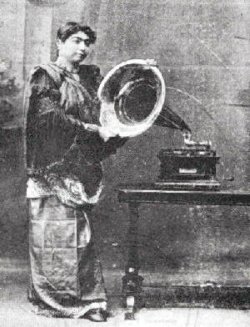
My Name Is Gauhar Jan – these words added spontaneously at the end of a 78 rpm record by one of the most prolific artists of Gramophone Company more than a century ago started a trend in recording, which continued many years after Gauhar’s golden voice faded out. In 1902, Gauhar was requested to record her songs for the first time by the Gramophone Company – she was the reigning diva of Calcutta entertainment industry then. Gramophone Company’s Engineer F W Gainsberg wrote that she was instrumental in ensuring early success for this new medium in India. For every “performance” Gauhar used to charge a princely sum of 3000 rupees! Gainsberg or for that matter, anyone in his place would have been ready to pay that amount for the most popular singer-dancer-entertainer of the era, who could sing in 20 languages and dialects including flawless English. But what astonished Gainsberg more than her singing prowess was her wealth and fashion statement – she always came in a new gown and never even repeated her jewels!
Gauhar Jaan gave her maiden performance at the age of 14 at the court of Maharaja of Darbhanga in 1887 and since then came to dominate Hindustani classical music-dance scene for the next few decades. She was pretty with beautiful eyes and had a rich voice but more than that she was intelligent and could floor any connoisseur with her magnetic charm. Her new compositions along with her new fashion styles and quick repartee used to leave her rich patrons spellbound. She was much more than an ordinary tawaif – her rendition of thumris and dadras were copied by budding classical singers, including a young Begum Akhtar. She belonged to that era of transition, where thanks to large-scale concerts at the houses of some of the rich patrons and then with Gramophone records, she could enthrall even ordinary music aficionados. And thus the legend of Gauhar Jaan was born. Even almost a century later, Gauhar still captivates us as the last diva of the pre-silver screen era. A recent book by Vikram Sampat – which very thoughtfully comes with a CD of her songs – captures the mystique of Gauhaar Jaan effectively. I recently also happened to watch a (highly forgettable) Bengali play on her life – Jaan-e-Kolkatta.
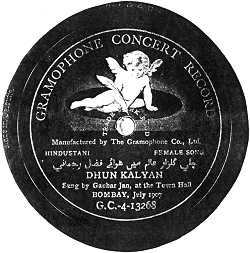
Gramophone Company 'Concert' 78 label - Gauhar Jan singing 'Dhun Kalyan' at the Town Hall, Bombay
Angelina Yoward, an Armenian Jew, was born on 26th June 1873 at Ajamgarh, UP.  Her father William Robert Yoward was working at a dry ice factory there. Her mother Victoria Hemmings was born and brought up in India and received training in Hindustani Classical music and dance. A few years after Angelina’s birth, Victoria ran away with a minor Muslim noble man. It was then Victoria adopted Islam and changed her name to Malka Jaan and Angelina became Gauhar. Gradually Malka became a famous Kathak dancer and classical singer in Benaras-Lucknow circuit. She came to be known as Badi (eldest) Malka Jaan, as there were at least three other tawaifs of that name then and she was the senior most. With Calcutta – the seat of power and business - emerging as a capital of culture too, Badi Malka shifted base in 1883 and found herself at the court of exiled Nawab of Lucknow, Wajed Ali Shah.
It was in Calcutta, Gauhar received training from the best experts of that time. After her first concert, she soon eclipsed other singers and as her record labels proclaimed, she was the “first dancing girl” of her time. She used to go to various royal courts all over India and gave performance at Town Halls in different cities. In 1911, she performed at the Coronation Darbar in Delhi, where along with Janki Bai of Allahabad, she sang “Muarak ho Mubarak ho, tajposhi ka jalsa”. It is believed that her recording of a Khayal in Raag Jogiya in November 1902 is the first Gramophone recording in India. She recorded in her life time a mind-boggling 600 records in different languages and was chiefly instrumental in popularizing light Hindustani classical. Very few people could actually gain entry to her famous Chitpur Road residence or afford to invite her for a performance. But her mystique was partly built on that – an extraordinary talent not easily accessible to public. It is said that Gauhar used to drive past Calcutta Maidan in her huge phaeton and was once fined Rs 1000 for obstructing the passage of the Viceroy, who apparently charmed by her beauty took his hat off and acknowledged her greetings!
Gauhar, incredibly rich at the height of her fame, lost her wealth and properties due to machinations of her manager turned husband. Gauhar – Court Singer at different points at Darbhanga and Rampur, finally decided to go to Mysore in late 1928 as a Palace Musician after she lost even her Chitpur Road and Free School Street residences. Gauhar died in Mysore on January 20, 1930. Before that in Calcutta, a broken heart Gauhar was forced to teach young stars, where she reportedly sold a bandish for one rupee but could not bring down herself to accept fees from her students directly. One of her students later recounted how she used to leave coins under the pillows. As Bombay eclipsed Calcutta as the centre of entertainment industry in late 1930s, along with many others this student of Gauhar, Jaddan Bai shifted base to Bombay, where she sang and acted in films. Very few people today remember Jaddan Bai, but all of us know her famous daughter Nargis, who was born as Fatima Rashid in Calcutta in 1929.

Sunday, March 6, 2011

Ancient Analog

One of my few complaints against my favourite magazine The Economist is that they do not normally give much space to non-political, non-economic topics even though their treatment of such topics is always very interesting and thought provoking. So I was pleasantly surprised when the cover story in a recent issue was on a new technology – Print me a Stradivarius: The manufacturing technology that will change the world (The Economist, February 12th -18th 2011). It talks about a revolutionary new  

  technology called additive manufacturing. This technology uses 3D printers to produce real life objects (as per your design) by putting layers after layers of the basic material (hence the name additive). The cover carries picture of a violin made using a 3D printer, which the magazine certifies, plays beautifully. From a simple coffee mug to aircraft parts you can literally create a world of your own with the help of this technology. Economist predicts that if the Industrial era was about mass production then this technology of new generation cottage industry is likely to disrupt the entire socio-economic foundations of the present global economy. There is a long list of possible disruptions from assembly line manufacturing and competitiveness of Asian manufacturers to urban life and intellectual property regime – but one has to agree with the magazine’s conclusion that in the long run it is bound to expand not only the realm of industry but also of human imagination.
How far you can expand your imagination while thinking about technologies in the ancient world? No, I am not talking about whether Pushpak raths were actually aero planes or such stuff. As far as our knowledge goes (and honestly that is not very far) the most amazing machine manufactured in the ancient world (of which we have definite material evidence) was almost like an analog computer (albeit for only a given subject).
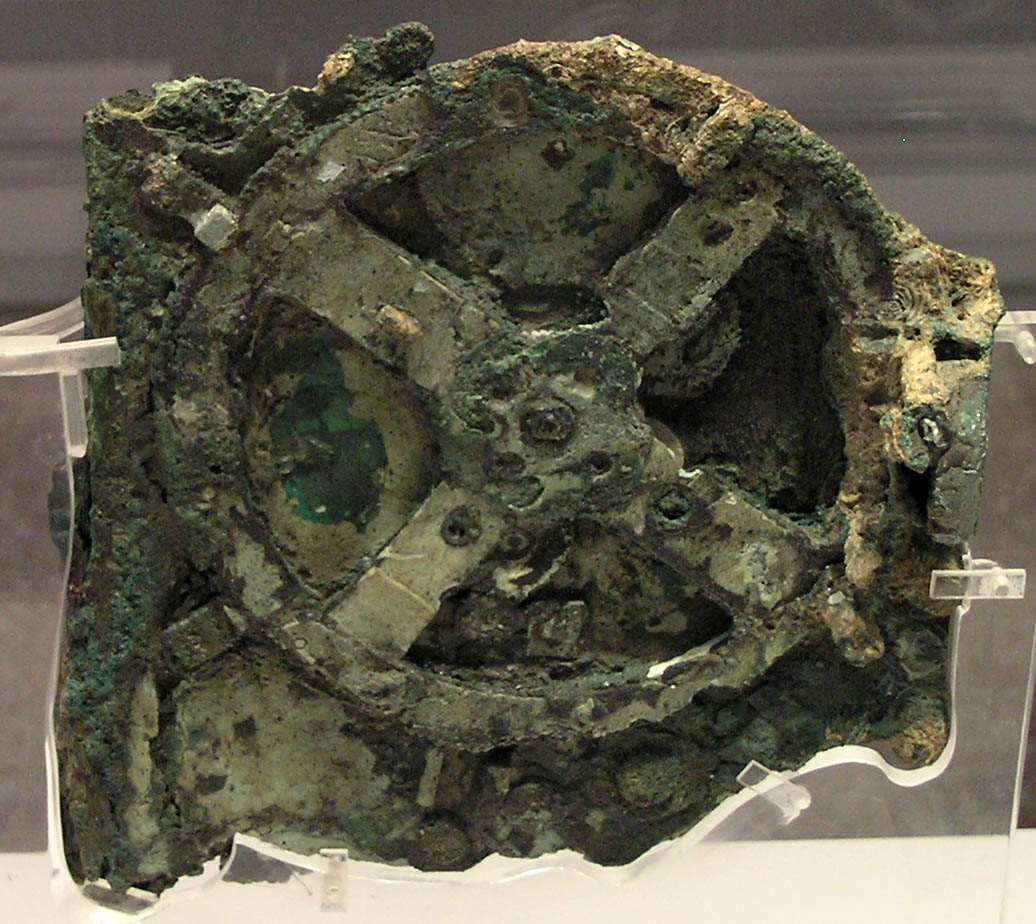
See Explanation.  Clicking on the picture will download
 the highest resolution version available.
First time when I heard about it I could not really expand my imagination to accept that such a thing was in fact manufactured in the second century before Christ. In 1900-01, sponge divers off Point Glyphadia on the Greek Island of Antikythera recovered certain articles from a shipwreck site. The ill-fated ship went under water sometime in the 1st or 2nd century BC. Among the recovered articles was a mechanical

 device since known   Antikythera mechanism. It took experts actually decades to fully understand how it worked – perhaps because they could not really expand their horizon of imagination and also because certain parts of the machine were lost. Now the device is displayed at National Archaeological Museum at Athens along with a full size reconstruction. Replicas of this amazing device could also be seen in a number of other prominent museums around the world, including at Computer History Museum at Mountain View, Calif. not far from the headquarters of Google.
The device is actually a multi-geared programmeable machine, which could predict exact astronomical positions at a given time. In terms of sheer mechanical complexity, the world did not see anything like it till at least 14th century, when mechanical clocks were manufactured for the first time in Europe. The device had over 30 gears (according to one researcher it actually had 72 gears!) and three dials- one in front and two at back. After a date was entered via a hand crank, the device used to give exact position of Sun, Moon and other planets including Mars and Venus on that date. Front dial had three hands to show the date and positions of Sun and Moon. Front dial also contained marks of the ancient Egyptian calendar (Sothic Year) and Greek Zodiac signs. Another outstanding feature of the device was that in all these there were adjusting mechanisms for Leap Year (in Sothic Calendar, till the invention of Julian calendar in 1st century AD no calendar had provision to adjust extra 0.24 days per year) and anomalies in orbits of Sun and Moon. It has now been proved that the actual calculation behind the machine was based on Babylonian astronomy and not on Greek astronomy. But the complexity of the device simply goes on to show the incredible depth of knowledge the creators had in mathematics and astronomy besides their amazing skills in mechanical engineering. The front dial also contains a parapegma, precursor to modern almanac. Two back dials show divisions of  Metonic and Saros Cycles respectively – all these were somehow very important in prediction of exact date, timing and planetary positions. It is of course quite difficult for a non-specialist to understand but not so difficult to appreciate the enormous knowledge behind this rather small device. The full size model made by Derek de Solla Price shows how wonderfully it worked.


 Reconstructed model of Antikythera mechanism by Derek de Solla Price
The fact that it was so brilliantly designed and then sort of miniaturized indicates that there was a tradition of such mechanical activity before this particular device was manufactured. Two important questions come to mind – who built this and how the tradition was lost? For the first, there are some speculative answers – one of the latest researchers says it was some way connected with the great scientist Archimedes. Others talk about an academy founded by Posidonius in the island of Rhodes, which was known for its expertise in astronomy and mechanical engineering in ancient Greece. I could not find any answer anywhere in the internet about the second question. There were suggestions that some of the skills behind this device might have survived in Byzantium and then in the Islamic world- but that is hardly a satisfactory explanation. It must be considered a matter of great regret that such advancement in technological knowledge achieved in the second century BC could not be sustained by mankind.
  Antikythera Mechanism continues to amaze and puzzle us more than 100 years after it was rediscovered.Now there is a full-fledged project dedicated to this extra-ordinary machine-the Antikythera Reaserch Project is fittingly being carried out by a number of Greek Universities , University of Cardiff and computer giant Hewlett -Packard. 

Wednesday, January 19, 2011

Medicine Men of Ancient India

 One day one of my friends – a truly argumentative North Indian – went on fighting with me on Bengal caste system, more specifically about the Baidya caste. I felt the main problem in bridging our respective understanding of non-Brahmin literary castes (like Kayasth) was the absence of a specialized caste for doctors in North India. Perhaps – my knowledge of Indian caste system is limited – there is no equivalent of Baidyas in the rest of India. Outside Bengal, it was mainly the Brahmins, who practiced Ayurveda. On another occasion, recently my wife (another North Indian) was really surprised to know that my gotra is Dhanvantari. Again I do not know whether most Baidyas in Bengal have this particular gotra but any one remotely interested in Indian myths would recall Dhanvantari was the person, who received the knowledge of medicine from Brahma and was deified as the God of medicine.
Ayurveda – literally the knowledge of long life was known to Indians from around the second millennium BC. For the first time we find mention of a separate branch of knowledge to deal with medicine in the Atharvaveda, which was compiled sometime between 1500 and 1000 BC. It is believed that the great text of Sushruta Samhita was written sometime around 700-800 BC and the great surgeon performed his miraculous surgeries before 800 BC! The earliest dated manuscript – Bower Manuscript is however from the third or fourth century AD. We have a tendency to gush over hoary heritage but even a cursory look at the Sushruta Samhita would confirm the tremendous progress made by ancient Indians in medicine. The book was organized in 184 chapters and gave details of more than 1100 diseases. Details given about human anatomy confirms that there was no taboo on dissection. The book contains details of more than 700 medicinal plants but more than that it provides details of mineral and animal preparations – in the 16th century, the
great pioneer Paracelsus (after his extensive tour of Asia) became the first doctor in Europe to use minerals in medicine.

Sushruta, more than anything else is known as the father of surgery – I find it simply mindboggling that he knew about most of the regular surgical methods used by allopathic doctors till around 1950. These include all types of fracture management, caesarian section, plastic surgery and hold your breath, cataract surgery.  He used a special curved needle – called Jabamukhi shalaka to push cataract out and then used to soak the operated eye in warm butter! A British surgeon Joseph Constantine Carpue spent 20 years in India at the beginning of the 19th century to learn plastic surgery methods described by Sushruta. Among the methods he leant was a procedure called rhinoplasty - how to use a flap of skin taken from forehead (or other part) to reconstruct a nose. In the western world, Carpue performed this surgery for the first time in 1815 – since then it is known as Carpue’s operation. Rhinopasty across the world is still done in the same method as described in Sushruta Samhita. This is just about Sushruta Samhita, equally if not more impressive is Charaka Samhita (written during the Maurya period) and various other texts.
At least for 3500 years, Vaidyas have served the society across the sub-continent. They tried to find locally available cure for every deadly disease and tried to treat every individual patient differently – something allopathy is trying to do now at much higher level through gene profiling and tracking family medical history. Arab conquest of Sind (712 AD) facilitated transfer of Indian knowledge to the Middle East. Both the physicians at the court of Khalifa Harun Al Rashid in Bagdad were Hindu doctors from Sindh. Sushruta and Charaka Samhita were translated into Arabic by 8th century AD, travelled to Spain and Sicily – two entrepots of knowledge for Christian Europe – and put to practice by Italian doctors.
In the last two hundred years, allopathic medicine has progressively reduced the role of Ayurvedic doctors. Till my great grandfather, all the men in my family practiced Ayurveda. None of his sons or grandsons showed any interest in his vocation. My great grandfather used to practice in Murshidabad and Barddhaman. I used to be a regular visitor to a house at Sealdah in central Calcutta, where my friend’s great grandfather used to earn his living as an Ayurvedic doctor. None in his family also showed any interest to preserve his knowledge.
But the greatest contribution of generations of Ayurvedic doctors has been to instill a sense of well being in our daily routine and in our kitchen. When we eat or avoid a particular substance at a given season or time, we silently pay respect to all those progeny of Dev Dhanvantari, even if we never visit any Vishagacharya any more or disagree on the origin of Baidya sub-caste.

PS: Well, I must admit I know nothing about Ayurveda, my purpose was to tell an interesting story about this great tradition. I am really happy that so many of you felt interested about the subject. Ayurveda Unravelled by Sharadini Dahanukar and Urmila Thatte (National Book Trust) is a good book to begin with. For my Bengali friends, there is a whole series called Chironjib Banausodhi by Kabiraj Shibkali Bhattacharya (Ananda Publishers) - I have just flipped through some of the volumes, it is rich in information but to what extent tested in a modern lab I have no idea. There are also a number of books now in English mainly from Kerala on pharmaceutical side of Ayurveda.
Central Council for Ayurveda and Siddha is the official research body for sarkari research effort in India, even though their output seems quite limited so far  http://www.ccras.nic.in/
Important texts are supposed to be preserved in National Instt of Medical Heritage in Hyderabad- http://iihm.ap.nic.in/
another decent site (at least looks to me) - http://www.ancientayurved.co.in/
In recent years people have become more interested in Ayurveda - but unfortunately more emphasis has been on the wellness side (Ayurvedic spa etc) of it. In comparison, Chinese traditional medicine has received far more serious research interest. The World Health Organization (WHO) accredits Ayurveda as a medical science, even adapting its definition of health as “a state of complete physical, mental and social well-being" - therefore it would be in the interest of the entire mankind if doctors/pharmacists/researchers take it up more seriously.