Pages

Friday, May 18, 2012

Pharma Robinhood: The Story of Cipla


Dr Y K Hamied, 75-year old Chairman of India’s second largest pharmaceuticals company, Cipla is trying to re-write the contemporary history again. On May 3, Cipla shell-shocked the entire pharma world with its astounding decision to cut prices of three key anti-cancer drugs by as much as 75%. In Indian market, kidney cancer drug Sofraneib (Bayer’s Nexavar) will now cost only 6840 rupees for a month instead of current Rs 28000; lung cancer drug Gestinib (sold as Iressa by Astrazeneca) will cost 4250, down from Rs 10000 and brain tumour drug Temozolamide (sold by Schering) will cost just 5000 a month, one-fourth of present Rs 20000. Even as pharma multinationals are busy devising strategies to contain this latest assault from India’s generic czar, Dr Hamied has said that soon Cipla would cut down prices of another 6 key anti-cancer drugs. For millions of Indian cancer patients – every year India reports at least 2.5 million new cases – and their families, there could not have been a better news than this as most of them cannot afford these medicines or sustain it beyond a few months. Actually the story started almost two months back when India’s drug regulator granted first compulsory license to Natco Pharma to manufacture and sell Sofraneib for just 8800 rupees a month in larger public interest. But the entry of Cipla in this latest theatre of pharma war changes everything.


Had it been any other person then perhaps we would have greeted this news with a bagful of salt. But with Dr Y K Hamied, it is a different story altogether – in September 2000, at a meeting of European Commission, he shocked the world of big pharma and global policy-makers by announcing that he was ready to provide a three drug cocktail of anti-HIV drugs at just $1 a day. The cocktail (combinations of reverse transcriptase inhibitors like Lamivudine, Stavudine/Zidovudin and protease inhibitors like Ritonavir, Indinavir) – then the only combination available for slowing the progress of HIV/AIDS – used to sell at $12000 for a year. Even though big pharma companies actually called him a thief and pirate; policymakers, particularly African leaders rolled out red carpet for him. Dr Hamied kept his word – under special licensing, first Cipla and then a number of Indian companies were able to provide the live-saving drugs at a fraction of a price being charged by multinationals. A New York Times report last year estimated that when Cipla handed over its first consignment of one year supply of drugs per patient at around $300 to Medicines Sans Frontiers, just around 2000 patients worldwide were able to afford the treatment. Today six million people across the world – particularly in the developing world - are daily availing this treatment. AIDS pandemic appears much more manageable and prices have fallen to 20 cents per day.

Acharya Prafulls Chandra Roy, founder of Bengal Chemicals, India's first modern pharmaceuticals manufacturer
Starting from Acharya Prafulla Chandra Roy and his Bengal Chemicals and Dr U N Brahmachari, India’s first successful medical innovator turned entrepreneur to traditional drug manufacturers like Dabur, Baidyanath and Hamdard, India has a hoary tradition of modern pharma manufacturing. But the real turning point came in 1970, when a new process patent regime came into being in place of old product patent – it is believed that one of the key advisors to Prime Minister Indira Gandhi behind this move was Dr Hamied. Though in the new millennium, after joining the WTO, India finally reverted back to product patent but this protection of more than 30 years made Indian pharma companies champions of reverse engineering. They would come out with copycats of a new drug soon after it is launched in market but would claim that they have produced it through a different process. These copycats – technically bioequivalents – are called generics as opposed to branded medicines. It is a legacy of that single master stroke in the 70s, that India today is a global leader in generics (India files maximum number of ANDAs or Abbreviated New Drug Applications with USFDA, required to formally launch a copycat drug) and the world’s third largest drugs manufacturer with nearly 20000 registered drug companies and more than 100 USFDA-certified manufacturing facilities.

A patent normally grants 20-years exclusivity to the holder, but on public health grounds, even the USA permits generic drugs ro ensure affordability. So far generic companies were able to copy only simple formulations. India and China together already control more than 80% production of active drug ingredients. Now with advanced facilities, they are closing in fast on complex bio-tech drugs used to treat cancer, diabetes and other diseases. Cipla and its Chinese partner BioMab have invested nearly $200 million in new production facilities to manufacture these complex drugs. Global pharma giants fear that within next one year or so Indian and Chinese companies would be able to sell most of their current blockbuster drugs. Compared to anti-retroviral drugs (which had a small share in their profit pie), what is at stake here is actually the very survival of these companies. For instance half of Roche’s annual sales of around $40 billion now comes from three drugs – Herceptin(for breast cancer), Avastin (for Colon cancer) and Rituxan(for non-Hodgkin’s lymphoma) and generic versions for all three are scheduled to hit the market in near future.

Reaction from the global giants and the self-proclaimed upholders of strong patent regime came along the expected lines. The crux of their argument is that this kind of porous patent regime would kill any incentive for new drug discovery. But Cipla along with other Indian (and some Israeli) companies have demonstrated that you can still make money by selling drugs at drastically reduced prices – that simply means these pharma giants are selling life-saving drugs at unacceptably high margins. When the fight is actually between saving human lives and naked profit then the verdict - at least in the long term – has to go against these companies. It is a matter of deep shame that both the USA and the EU – in the garb of intellectual property rights, patent etc – are trying to promote the interests of limited few against the suffering multitude.
Dr K A Hamied, founder of Cipla
Born in Lithuanian capital Vilnius – his mother was a Lithuanian Jewish socialist - Dr Hamied grew up in Bombay and now lives mostly in London. In Bombay, as a school boy he used to play cricket with his neighbourhood friend Zubin Mehta. It is no wonder that Dr Hamied himself is a devoted fan of Western Classical music. His father Dr K A Hamied studied in Germany and then came back to teach at Aligarh. A disciple of Mahatma Gandhi, he was one of the founders of Jamia Milia Islamia before setting up Chemical, Industrial and Pharmaceuticals Laboratories, which came to be known as Cipla. Even today, the pride of place in Cipla’s website goes to Gandhi’s visit to Cipla factory in 1939. Dr K A Hamied also drafted the blue-print of a chain of nation-wide scientific research institutions, which led to the formation of CSIR, the apex scientific research body in India.
Dr Hamied receiving Padma Bhushan from Prez Kalam
Today Dr Y K Hamied runs a charity cancer hospital in India and funds research in his alma mater, Christ College, Cambridge, where Yusuf Hamied centre opened its doors in 2009. Time and again Dr Hamied has underlined Cipla’s social commitment and humanitarian concerns. Cipla has managed to fulfill that without having to compromise its balance sheets. As he embarks on another pioneering journey, along with millions of cancer patients and their worried friends and family, the entire humanity would be praying for his success.

P.S. 1. cancer drug price protest in the USA http://articles.economictimes.indiatimes.com/2012-05-15/news/31711440_1_novartis-india-anti-cancer-drug-generic-drugs
2. Alternative model for innovation http://economictimes.indiatimes.com/opinion/comments-analysis/shift-from-patents-regime-to-prize-based-system-will-revolutionise-research-and-healthcare/articleshow/13335304.cms
3. Compulsory licencing upheld http://www.thehindu.com/opinion/op-ed/patients-win-over-patents/article4482469.ece

Saturday, April 21, 2012

Calcutta: Requiem for a City

Every time I come out of my flight at Netaji Subhas Chandra Bose International Airport and then on to the roads of the City of Joy, I get a distinct feeling of being back in my native village. This time as I came out of the airport – dirty and shabby as usual – and landed bang in the middle of a complete traffic chaos in a crater-filled dirt track (perhaps ironically called VIP Road), I could not help being pessimistic. Almost a year back the city welcomed with great joy and relief a new party into power after 34 years of communist rule - and the only signs of change are some blue paint and a new-design of street light, which, I was told, was so designed as it bears a close resemblance to the electoral symbol of the party in power.

2011 also marked the centenary of a landmark event, which of course no true Calcuttan could celebrate. Hundred years back in December, 1911 in a dusty corner of old Mughal capital, the British Monarch announced shifting of the capital from Calcutta to Delhi. Calcutta was then the richest and most progressive city east of Suez. A number of observers have remarked that 1911 marked the exact beginning of Calcutta’s decline. But even in the 1960s, half a century down the line, Calcutta was the richest city and West Bengal was the most industrialized state of the union. Calcutta was, without much doubt, the cultural capital (minus Bollywood) too. Almost every day I come across – both physically and in the pages of newspaper - so many non-Bengalis, over 60 of course, who had close links with the city. It was mostly in terms of education, business and father’s employment. Calcutta, apart from the rich and middling Marwaris and often looked-down-upon Biharis and Oriyas, was home to a thriving Anglo-Indian population, along with sparkling presence of Parsis, Jews, Armenians, Tamils and others. Except for some Chinese, almost all of them have migrated away. Today most of the successful Bongs are also found outside Cal – anywhere from Denver to Dubai, San Jose to Singapore and inside the country, in Bangalore, Hyderabad, Pune, Bombay…..almost in any metro city, except Calcutta.
End of history on Park Street?
Today, Calcutta is essentially a provincial town – or a sprawling monochrome urban agglomeration. There is nothing metropolitan about its culture, society or economy. Internet gives two unique credits to Calcutta – world’s poorest 10-million plus city and the metro city with maximum annual rainfall in the world – I don’t know whether the statistics are correct but no doubt, they instantly conjure up some of the more well-known visual images of the city.
City is the greatest innovation of human beings. A city represents the essence of a culture, concentration of knowledge and functions as the engine of economy. It is no wonder that both the Anglo-French words – City and Civilization – come from the same Latin root. Growth or for that matter, decline of a great city, therefore, has to be seen in the context of the civilization it represents. From a silted Port to dilapidated palatial houses of North Calcutta to rusting workshops of Howrah - all point to an utter collapse of the economic foundation of that civilization. Without that base, it is no surprise that Bengali culture today looks more like a shallow and stagnated pool.  

I spent a week in Calcutta, on an average covering 10 kilometres in two hours – as a result I ended up spending more time on the road than meeting people. If you dare to stand at the Science City crossing for more than 10 minutes, you risk being choked to death. Forget AC, finding a taxi with a clean seat was impossible - foremost factor was of course whether he would be kind enough to take you onboard. Public space belongs to anyone but the hapless public and the entire city resembles a giant open-air garbage dump.

Street kids celebrating Saraswati Pujo - none of them goes to school
My last day in Calcutta was incidentally the day of Saraswati Puja – Valentine’s Day for Bengali youngsters. Travelling across the city – from Howrah to Rashbehari and then to Salt Lake and then back to Howrah through North Calcutta and then again to Central Calcutta – I saw scores of boys mostly in Pajama – Punjabi (kurta) and girls, invariably in (mom’s) saree. As they went around giggling, trying to balance new heels and very conscious about their first saree (Ami tokhon nobom sreni/Ami tokhon prothom saree…), Calcutta definitely looked a more vibrant place. I am sure the day would have brought new colours to a whole lot of them. I would not deny that some of them with shampooed hair and large, dark Bengali eyes did remind me of an almost forgotten singer called Nachiketa after a long time – Hotat khola chule, hoyto moner bhule, jokhon takato se obohele…..hazaar kobita….

Yet I could not help noticing absence of a dash of glamour – to put it differently, twenty years back this crowd I would have expected at Rishra than Rashbehari. A friend observed that today there is more socio-economic and cultural energy in South-suburban Calcutta (Behala-Bashdroni-Garia) and suburbs along the Sealdah and Howrah local train lines – from Agarpara to Srirampore. Their benchmark of success – a house/flat, steady job for son/daughter (ideally school service – Rail, Bank PO or WBCS is a significant improvement), Kerala trip in October and may be a small car. Neighbourhood hero is the software engineer currently abroad – hopefully he would be back before Pujo (never mind Durga Puja is just nine months away) - para club is going to celebrate its 60th anniversary with great fanfare. Kasturi Sweets makes phabulaas Hinger Kachuri and Chicken Manchurian at Aheli Café is ‘almost like Tangra’ – slices of life seen in established middle class Calcutta perhaps twenty years back. And that Calcutta now appears a pensioners’ ghost town – children settled abroad, annual trips, daily phone call or Skype – empty nest.

Eight of us – college batchmates – met at Flurys on a Saturday evening. Flurys was then transformed into Pramoda’s canteen for the next couple of hours. There is nothing like an adda with old pals to improve the quality of one’s existence. You can still largely ignore pollution, traffic and a host of other maladies as you sit down with some hot Kaapi at a non-descript South Indian joint with old friends or some delectable Mochar ghonto at Bhojohori Manna with another. This remains the greatest redeeming feature of Calcutta – its people.
Calcutta ultimately remains a bitter-sweet memory like your first love. She held out so much promise. Even today you wonder why Calcutta’s potentials are not realized to any extent. Why can’t we at least have clean sidewalks, motorable roads and less pollution? This – without any political agenda – itself will bring some business and with it job and talent back to the city. So many us would have been really happy to be back in this city for good – in the absence of basic amenities and lack of opportunities, that option simply does not exist today. After so many years you don’t really remember why did you have that fight on that Saraswati Pujo day – millions of years ago – you still pine for her. Kolkata jodi satti tilottama hoto!!

Monday, February 20, 2012

Political Fashion in India

In his Aligarh dress
Hakim Ajmal Khan, rais of Old Delhi, was a great doctor, institution-builder and one of the most important public persons of his age. Hailing from the most prominent Unani physician family of Mughal Delhi, Ajmal Khan started out in traditional Mughal dress of fitted coat over a long angrakha. Then he adopted the Aligarh dress of dark long sherwani and Aligarhi pyjama along with a matching broad cap. After joining Gandhiji, he shifted to Khadi and then when he went to Europe – to acquaint himself with modern medicine – he switched to western style suit. You are what you wear! And for people in public life, your dress needs to be tailored according to the message you intend to give.

Time magazine has recently listed Nehru Jacket as one of the top ten global political fashion statements. The magazine has noted that this dress, popularized by the first Prime Minister of India, descended from the North Indian court dress, achkan. Though Nehru typically wore a longish version of this dress over his tight Aligarhi; we know this dress better as a bandh-gala and typically associate it with politicians and bureaucrats. This dress is also known as Jodhpuri. After independence, this was adopted as the formal dress for official occasions. After his selection in Civil Service, every male officer is directed to report at Mussoorie academy with a black bandh-gala. In fact senior bureaucrats and Indian Foreign Service officers follow this dress code most diligently.

Sarkari bandhgala
All western male politicians – in fact most world leaders – mandatorily wear dark suits with a crisp white shirt. Only colour in their ensemble comes from the tie.  Compared to that Indian politicians display a great deal of variety. However a close inspection shows that they are also bound by stereotypes. It was part of Gandhiji’s well-thought out communication strategy to wear a simple dhoti (along with travelling in third class in railway and using simple Hindustani for speech) to identify with the masses. This has to be seen in contrast with the first generation of highly Anglicized leaders, who travelled by hiring an entire railway coach, always wore western suits and gave speeches in English. Charkha and wearing Khadi were important symbols of self-reliance and identification with the masses. Every Congress member was obliged to spin a certain amount on his/her Charkha. Soon Khadi dhoti-kurta and sarees along with the Gandhi topi became the official dress code of every nationalist.


Since 1930s, the broadly accepted dress code for Indian male politicians has been this khadi/handloom dhoti and kurta. Another common feature has been the adoption of a short, sleeveless, closed-neck (normally black) jacket with buttons in the middle. This is also commonly referred as Nehru jacket.  Senior leaders like Pranab Mukherjee or L K Advani effortlessly shift from dhoti-kurta to bandh-gala. P Chidambaram, normally seen in elegant crisp white dhoti-kurta, looks equally suave in business suites while travelling abroad.

Younger generation does not dare to challenge the dress code
Dhoti has now gradually been replaced in North India by pyjama. South Indian politicians wear dhoti – mundu - in their distinctive style. There would be minor variations here and there – some prefer cream colour shirts instead of white, Chandrababu Naidu for example. Narendra Modi wears a half-sleeve white shirt with collar. The humble farmers’ topi of Western India has largely become a Congress heritage till Anna Hazare’s recent movement, where every protestor was spotted with one such topi. Senior politicians in Himachal are never seen without their distinctive cap. In Punjab, Akali leaders are always seen in their trademark navy blue turban. Even politicians from other parties are known to prefer basic turban colours while on campaign trail – of course Navjot Singh Sidhu remains an honourable exception.
Nawab Collection by Canali
Rajiv Gandhi brought the last significant change in Indian male politicians’ attire. His youthful image of driving SUV in white kurta-pyjama with white snickers is still the model for the entire youth brigade. A recent trend however is to elevate this fashion statement – an insider revealed some of the white dresses nowadays are made from an imported fabric, which gives the look and feel of Khadi but is actually much more comfortable. Desi designers like Raghavendra Rathore already carved out a space for bandh-gala in fashion high table. Now top global brands have also joined in – one of the top draws this winter was a slim black bandh-gala by global fashion house, Canali.

Some women politicians are still seen in elegant chiffon or designer sarees. On the other hand, both Sonia and Priyanka Gandhi (particularly on campaign trail) are always seen in exquisite handloom sarees – closely following the tradition set by Indira Gandhi. Three notable women politicians from different regions are trend-setters in their own right. There have been endless talk about Mayawati’s pink salwar suits and accessories or Jayalalitha’s cape but hardly anyone follows their style. Mamata Banerjee tries to identify with her slogan of ma, mati, manush through her fashion statement of simple tant saree and slippers.
Santorum: Vote for Change
Though a minority of top business leaders abroad do not hesitate to discard their business suit – Steve Jobs being the most famous example - it is very unusual for Western politicians to break the mould. Time magazine was compelled to dwell on the subject thanks to Rick Santorum. A Republican Presidential hopeful, Santorum created waves by appearing in colourful cardigan-type half sweaters - sweater-vest in American lingo. In India, even younger politicians, except for one Omar Abdullah here and Priya Dutt there – do not want to challenge the archetype. Amit Mitra – not long back a senior industry leader, now appears mostly in kurta-pyjama in his new avatar as the West Bengal Finance Minister. When career politicians appear in their trade-mark dress – adopted ostensibly to bring them closer to their electorate – their appearance itself differentiates them from the public. Anna Hazare movement was a trend-setter in many ways – civil society leaders seemed absolutely comfortable in their everyday attire – something seen earlier with a fading generation of Marxists.

Monday, December 26, 2011

Jana Gana Mana: 100 Years of Our National Anthem

Jana Gana Mana Adhinayaka jaya he……from your morning school prayer to moments of India’s Olympic glory, there could be nothing more inspirational for an Indian to sing these lines along with unfurling of the tricolor. Our beautiful national anthem completes hundred years of singing today. On 27th December 1911, on the second day of annual session of  Indian National Congress in Calcutta, this song was sung for the first time (first day at inauguration, as usual the song of choice was Vande Mataram).  Written in highly sanskritized (tatsam) Bengali, the complete song of five stanzas under the title of Bharat Vidhata was published for the first time in 1912 in the Brahmo magazine Tattvabodhini Patrika, which Rabindranath used to edit at that time.

Rabindranath wrote and set to tune more than 2000 songs – these songs together are known as Rabindra Sangeet and started a new genre of music in Bengali. He grouped these songs under a few thematic categories – Prem, Puja, Prakriti etc. This song was entered in Geetabitan (his collection of songs) under the category of Swadesh or patriotic songs. In 1919, while visiting Besant Theosophical College at Madanapalle (Chittoor district of Andhra Pradesh), Rabindranath translated it in English. College Principal James Cousins’ wife Margaret, an expert in western music, wrote down the notation, which is followed till date. Framed original English translation in Rabindranath’s handwriting is still displayed at the institute. It was entitled The Morning Song of India.
Though the song was popular and sung at various Congress sessions, it was Netaji Subhas Chandra Bose’s Azad Hind Fauj (Indian National Army, INA), which first adopted it as the national anthem or what they called Quami Tarana. In fact Azad Hind Fauj adopted a simplified Hindustani version of the song – Subh sukh chain ki barkha barse, bharat bhaag hai jaga….It was translated by Captain Abid Ali and under Netaji’s direction, set to a martial tune, close to the original, by Captain Ram Singh Thakur (who is perhaps better known for INA's immortal marching song - Kadam kadam badaye ja, khushi ke geet gaaye ja). On 15th August 1947, when Jawaharlal Nehru unfurled the national flag at Lal Qila, Captain Thakur was especially invited with his band to play the anthem.
Captain Ram Singh Thakur playing violin
During the freedom struggle, the real battle cry of freedom fighters was however Vande Mataram, written by Bankim Chandra Chattopadhyay. First published as a part of his famous novel Anandamath in 1882 and first sung at the Benaras Congress session of 1896 it became a clarion call since the Swadeshi days in Bengal. The song was however not really acceptable to the Muslims due to the idea of a mother goddess behind it. It was also not very easy to sing it.
Bankim Chandra: First graduate of Calcutta University:
 first serious prose writer in Bengali, single-handedly defined Bengali language
In 1947, the Indian delegation to the United Nations was asked to play their national anthem. They played the only such recording they had with them – a band version of Jana gana and the tune, in Pandit Nehru’s language “..struck the listeners as distinctive and dignified”. Since then, military bands and Indian embassies were asked to play this tune. Nehru highlighted the difference between Vande Mataram and Jana gana mana beautifully, “…Vande Mataram is obviously and indisputably the premier national song of India with a great historical tradition; it was intimately connected with our struggle for freedom……It represents the passion and poignancy of that struggle, but not so much the culmination of it." Finally on 24th January 1950, the Constituent Assembly adopted Jana gana mana as India's national anthem. This was the last resolution to be adopted by the Assembly before the new constitution was signed and came into force on 26th January, 1950.

In modern times, an independent nation is expected to have a constitution of its own, a national flag and a national anthem to define its identity. The concept of national anthems originated in late medieval Europe as modern nation states were coming into being. Dutch national anthem, Wilhelmus – written between 1568 and 1572 is generally taken as the oldest national anthem. Though a number of national anthems are quite famous but their creators are relatively lesser known. It is not even known who composed the British national anthem - God Save the Queen. Only two national anthems are created by world famous composers – Haydn wrote the music of German national anthem and Austrian anthem is sometimes attributed to Mozart. Apart from Rabindranath, the only other Nobel laureate to create a national anthem was   Bjornstjerne Bjornson of Norway.

Ananda Samarakoon
Amar sonar Bangla ami tomai bhalobasi – another famous Rabindra Sangeet from the Swadesh series and written at the height of Swadeshi and Anti-Partition Movement in Bengal (1905-11) is today the national anthem of Bangladesh. This is a rare and perhaps the only case in the world where one poet was behind the creation of two national anthems. In fact it does not stop here – few people claim Rabindranath also composed the national anthem of Sri Lanka – Namo Namo Matha, Apa Sri Lanka (words were later changed to Sri Lanka Matha, Apa Sri Lanka). But what is more acceptable that the song, written by Ananda Samarakoon, a Sri Lankan student of VIswa Bharati, was deeply influenced by Rabindranath. Rabindranath visited Sri Lanka thrice and was a major inspiration behind Sri Lankan cultural renaissance. Samarakoon, influenced by Rabindra Sangeet, pioneered a new form of artistic Sinhala music.

Thursday, December 22, 2011

Making of New Delhi: Imperial Vision to Real Capital

The dome above the nation: Illuminated Rashtrapati
Bhavan with Jaipur Column in front
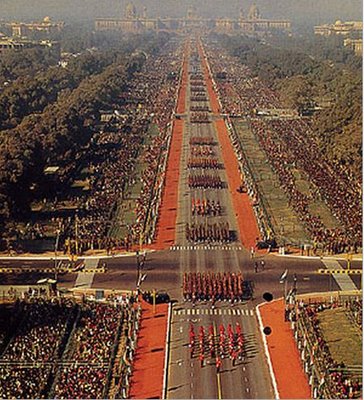
Capital was shifted in 1912 but the arrangements were makeshift. What is today the Delhi Vidhan Sabha (near Delhi University) was the first Secretariat and University Vice-Chancellor’s office was the first Viceregal Lodge. As Lal Qila was the focal point of Shahjahanbad, Viceroy’s House was supposed to be the central pivot in the lay-out of new imperial capital. The site of the Viceroy’s House was finally fixed at a village called Raisina (two other choices were north of Civil Lines and Malcha village, Chanakyapuri). Under the supervision of Edward Lutyens and Herbert Baker the new capital took shape between 1911 and 1931. Lutyens designed the glorious Rashtrapati Bhavan and Baker imposing North and South Blocks – a splendid mix of classical style with Indo-Saracenic features. Among the major contractors was Khuswant Singh’s father Sobha Singh (Khushwant’s father-in-law Teja Singh Malik, who rose to become the first Indian Chief Engineer of CPWD was another key person). The new city in many ways presented a seamless vista with the existing landmarks. They drew a straight line from the Rashtrapati Bhavan to Purana Qila through the War Memorial (India Gate). This road, called Kingsway (today’s Rajpath) - was the main axis. Around this came up palaces of great Kings (of Hyderbad, Jaipur, Bikaner – most of these buildings are in government’s hands today and quite poorly maintained, except for Hyderabad House) and to the south of Rajpath the elegant bunglow zone. When the great city wall of Shahjahanabad was partially broken down, affected people were shifted to Karol Bagh. Lot of institutions also came up there. Lodhi Colony and areas around Gole Market housed government servants. One of the offshoots of the shifting was founding of the Delhi University.
South Block
There were scenes of unprecedented jubilation in Delhi on 15th August 1947. Prime Minister Nehru unfurled the trocolour at Lal Qila. Since then flag hoisting on 15th August at Lal Qila and Republic Parade down the majestic Rajpath are two major annual events in Delhi.
Republic Day Parade
Independence also brought trauma of Partition. It was here at Birla House on 30th January, 1948 Gandhiji was shot dead by a Hindu fanatic Nathuram Godse. More than 3 lakh Muslims left the city in 1947 – more than the number, it was the profile of the emigrants, which created a gap in terms of economy, culture and leadership of the community. On the other hand, nearly 5 lakh Hindu-Sikh refugees came to Delhi. Population of Delhi increased a staggering 90% between 1941 and 1951 as refugees continue to pour in. This completely changed the profile of the city. “Mughal twilight” in the Old City came to an end and New Delhi, beyond the political-bureaucratic Lutyens zone, became a Punjabi city.
Future Perfect? Refugees near Purana Qila 1947-48
The refugees first lived in massive tent cities in different parts of the capital with the Kingsway Camp (Coronation Park) ironically being the largest of them. Some of them were settled in houses left by Muslims evacuees. New colonies like Lajpat Nagar, Malviya Nagar, Patel Nagar (all named after Hindu leaders and also notice "Nagar") and markets like Sarojini Nagar and Kamla Market were built for them. After independence, first official expansion was Chanakyapuri – the diplomatic enclave, followed by more government colonies with RK Puram being the largest. Soon Delhi was expanding on all sides - private developers like DLF developed areas like Hauz Khas and DDA built apartments in different areas. 
Lotus Temple: Delhi does not have a skyline, only impressive individual monuments
Delhi has always been a political capital but over the years it has evolved into an economic power house and hub for education and culture. Refugees infused new life into business. Small factories started coming up in and around the city. Some of these businesses like Ranbaxy went on to become great success stories. During the initial years, cultural activities were limited around state-sponsored institutions in Lutyens Delhi but today thanks to its diversity, presence of government agencies and embassies, today no other Indian city can match Delhi in terms of sheer variety of cultural events. Similarly, over the years, Delhi has become an education hub with premier institutions like Delhi University, IIT, JNU etc. Yet what Delhi lacks is social culture. There is no cohesive social identity of the city. A city of perennial immigrants, Delhi has within itself mini-Bengal, mini-Tamil Nadu and localities with different flavours....but there is no cohesive identity of either the city or its society. This reflects in its attitude to women, apathy for downtrodden and a general lack of involvement. Very few cities in the world can claim to have such a rich legacy yet most Delhites remain completely ignorant of their heritage and see the city only as a provider of their livelihood.
 
Height of Delhi Punjabi cuisine: Butter Chicken at Moti Mahal
 Emergency was a difficult time for Delhi, especially for the poor as Sanjay Gandhi embarked on his twin schemes of bulldozing all shanties and sterilization of poor. Legacies of that period are resettlement colonies like Seelampur, Mongolpuri and in a way better communication between the city and its peripheries. 1982 Asian Games helped to upgrade city infrastructure and brought in first flyovers. In 1984, assassination of Indira Gandhi sparked off terrible riots against the Sikhs. This was an image of barbaric Delhi. Then there were waves of agitations –Bofors, Mandal and Ram Janambhoomi. Since then Delhi has also been routinely scarred by terror attacks – including several serial blasts and an attack on Parliament in 2001.
 
Metro Man E Sreedharan: Nothing has changed Delhi more than the metro
Post- economic reform Delhi became posh. New economic opportunities started attracting talent and labour. Now there are substantial populations from UP, Bihar, Bengal as well as from the South and North East. Presence of so many ethnic groups with their varied culture, language and cuisine has helped Delhi to emerge as a true capital of India. Recent introduction of metro and infrastructure development due to the Commonwealth Games have made at least parts of Delhi world class.
Gurgaon Skyline
Delhi of new millennium is to a large extent a story of superb suburbs. Gurgaon has emerged as a global back office destination. Faridabad, established as a small scale industry hub, has reinvented itself as a middle class paradise. Noida, once labelled as a retirement hub of babus, has got a swankier twin in Greater Noida and is staging F1 race now. Their collective story is that of Delhi’s new found economic might and global ambitions.

Tuesday, December 13, 2011

Birth of New Delhi: Coronation Darbar 1911

Mir Nihal headed towards Chandni Chowk early morning on 7th December, 1911. After a long wait, the five mile long royal procession slowly emerged out of Lal Qila. From a distance he could not even identify the firangi King (the new queen told the officials flatly that neither she was going to sit atop an elephant nor would allow the King). But the great pageantry with guns booming in the background reminded him only of India’s servitude. Sitting in front of Jama Masjid, Mir Nihal remembered how in 1857, the British forces after re-capturing the city thought of blasting away the great mosque. As Nihal – a member of the fading Mughal elite - sat there, images of Delhi’s past glory flashed before him. On his way back home, he met a lame beggar, said to be the youngest son of the last emperor Bahadur Shah Zafar – these haunting scenes from Ahmed Ali’s classic Twilight in Delhi are difficult to forget.

Coronation Park
Five days later, on 12th December, at the Coronation Park George V was anointed the Emperor of India. A new crown was designed for the occasion at a cost of 60 million pounds – a matching tiara (now called Delhi Darbar tiara) was presented to the Queen on behalf of the ladies of India. After the royal couple was anointed, all the reigning Kings of British India were trooped in to do their salaam – this included the lone lady, Begum of Bhopal, who was modestly attired in a traditional dress but wore a pair of tennis shoes! Maharaja of Gaikwad Sayyaji Rao II appeared without any jewellery and turned his back on the King after a simple bow – this enraged the officials as a sure sign of rebellion by the independent-minded Maharaja.

Jharokha Darshan of English King: Lal Qila 1911, minor Indian princes were used as Royal Ushers
Just as the official function got over with the national anthem God Save the King, George V surprised everyone – “We are pleased to announce that......we have decided upon the transfer of the seat of the Government of India from Calcutta to the ancient capital of Delhi.......”
This was the defining moment in the modern history of Delhi. In 1857, Delhi was the nerve centre of revolt and British reprisal was most severe here. After 1857 Delhi was in terminal decline – a large number of Hindus and Muslims left the city - both to escape from possible reprisal and in search of better opportunities. In 1911, Lahore was more important than Delhi and Lucknow to the east was the largest city in North India. But history was on Delhi’s side. At least since 1000 AD, mostly this had been the capital of North India. Situated at the end of Indus basin and Punjab and at the mouth of Ganga-Yamuna plains; equidistant from the Northern Hills and deserts of Rajputana, this had been the most preferred location to rule the sub-continent. Also, the annulment of Partition of Bengal was viewed as a step against the Muslims, the choice of Delhi – the traditional seat of Sultanate and Mughal power - was a means to assuage that feeling.
In 1911, Delhi was a decaying old town. There was none of the cosmopolitanism or huge urban sprawl of capital Calcutta or the biggest city, Bombay. Total population of the city was just around 4 lakhs – there was serious dearth of modern professionals like doctors or engineers. Economic opportunities were extremely limited. Outside the walled city, there were only villages and some clusters - at Qutab and around Nizamuddin’s dargah. Even in the 1930s, there was nothing but agricultural fields between Safdarjung’s tomb (southern boundary of Lutyens Delhi) and Qutab. In the walled city, old Muslim and Hindu elites dominated. Kayasthas and Bengalis dominated government service and socially there were some tensions between them. Sahibs lived at Civil Lines and Daryaganj. Railway station brought some business. Mir Nihal’s neighbours were excited as the Coronation and then the shifting of capital brought more business.


A huge tent city was erected at the Coronation Park to accommodate visiting dignitaries and officials. This in many ways was a precursor to the imperial New Delhi that was going to come up. Coronation Darbar brought telephone for the first time in Delhi, substantially augmented power supply through a new power plant, led to establishment of elaborate street lighting and sanitation systems.
As the King finished his announcement, there was pin-drop silence for a moment then there was a huge round of applause. Old Delhites like Mir Nihal were not much impressed but businessmen were happy. People from neighbouring areas, particularly Punjabi traders were excited about upcoming opportunities. People in Calcutta were absolutely dismayed – on the other hand, humbling of its great rival made Bombay quite happy. The wheel of fortune turned once again in Delhi’s favour.

PS: A film was made on the entire ceremony - this was one of the earliest films made on a public event in India. This movie recorded in Kinemacolour was the first colour recording of an imperial event outside Britain. It was a great hit in New York next year. In YouTube, you can also see what exactly Mir Nihal saw on that day plus what he was not privileged to see five days later at the Coronation Park - that bit available in black and white - has got the footage of Begum of Bhopal and Maharaja of Gaikwad too.
Rare photographs of the event are preserved in Ebrahim Alkazi collection in New Delhi http://www.acparchives.com

Friday, December 9, 2011

Seven Capitals of Delhi

Indraprastha – the capital of the Pandava brothers – was built by Moy danav. The palace left Duryadhona absolutely awe-struck – unable to make out the difference between glass and water, he finally ended up falling in water. The scene prompted Draupadi’s contemptuous laugh. Duryodhana decided to take revenge for this humiliation – thus proceeds the story of our greatest epic, Mahabharata. According to traditions, Indraprastha was located at the site of present Purana Qila (Indraprastha or Indrapat was at the centre of five pats, the other four – Sonepat, Panipat, Baghpat and Tilpat – are located around Delhi). Excavations at Purana Qila have revealed different layers of habitations stretching backwards up to the Maurya period, though not beyond that. Scattered findings of Painted Greyware have been interpreted by some scholars as characteristics of Mahabharata period (before 1000 BC).
Remnats of city wall: Qila Rai Pithora
 In the historic period, Rajput Tomar King Anangpal established the first capital city Lal Kot around present Mehrauli in 1020 AD. Signs of city life were however visible around present Surajkund area from 8th century onwards. Tomars and following them the Chauhans expanded this city and  surrounded it by a wall – remnants of this wall could still be seen near Saket. This came to be known as Qila Rai Pithora in memory of Chauhan King and hero of many a legend, Prithviraj Chauhan.

After Pritviraj was defeated by Mohammed Ghori in 1192 AD, Ghori and then Qutubuddin Aibak ruled from the same Mehrauli area. It was here that Aibak and then Iltutmish built some of the earliest Islamic monuments in India, including the Qutb Minar. Remnants of destroyed Hindu mandirs, which were used in this construction, could still be seen at the Qutab complex.
Siri Fort
 Alauddin Khilji founded the next capital at Siri – some two miles north of Lal Kot (present Siri Fort area). It is rumoured that this was the scene of a great massacre of Mongol prisoners – since their heads (sir) were strewn here thus the name Siri! Within this city was located his famous palace – Hazar Situn or the Hall of Thousand Pillars.  Alauddin not only defeated the Mongols but also the Rajputs and invaded South India. He also built the great tank at Hauz Khas, though his ambition of building a pillar bigger than the Qutab (in the same complex) remained unfulfilled.
Tughlakabad
 Facing the Mongol menace once more, Ghiyasuddin Tughlak built a fort capital with huge sloping wall and bastions at Tuglakabad. Built on a rocky outcrop and suffering from immense heat and lack of water, the city had to be abandoned in just 15 years. Legend has it that after a difference of opinion between Saint Nizamuddin Auliya and Ghiyasuddin, Saint told the King, who was returning from Bengal that jackals would roam in his new capital and “Dilli” will always remain “door ast” for him. Ghiyasuddin was soon murdered by Mohammad Bin Tughlak just before entering the city.
Bin Tughlak’s story of shifting capital is well known but when he finally settled down in Delhi, he encircled the entire area between Qutab and Siri in a new city called Jahanpanah (Refuge of the World). Iban Batuta saw this sprawling city with its huge mosque (Begumpuri mosque) and royal palace (known as Bijai Mandal today) and commented that this was the biggest city in the Islamic world.
Firoz Shah Kotla
 Firoz Tughlak, Mohammad’s successor, was happy to give up military ambitions but was a great builder and the first conservator in the history of Delhi. He founded a new city – a fortress palace in fact, called Firozabad – today’s Firoz Shah Kotla. He also built a number of great mosques and cut the Western Yamuna canal, brought to Delhi two Ashokan pillars and repaired famous mosques and palaces of earlier periods. Today his capital is better known for the cricket stadium next door. Next came the Saiyyids and the Lodhis – some of the Saiyyid Sultans are buried at the Lodhi Garden – and it was during the time of Sikandar Lodhi that the capital was shifted to Agra.
Qila-e-kunha mosque, Purana Qila
After the victory at Panipat in 1526 AD, Babar headed straight to Agra, the Lodhi capital but left Humayun behind. It was Humayun, who founded the next capital city called Deenpanah at the site of today’s Purana Qila. Sher Shah, who also ruled from here after expelling Humayun, expanded it further. Humayun managed to come back after Sher Shah’s death but soon fell to death from the stairs of library building here. Humayun’s tomb, built nearby is the first major Mughal monument. Akbar after spending the first few years in Delhi shifted the capital back to Agra.

Humayun's Tomb: First Great Mughal Monument
No other city in Indian history evoked so much passion as Shahjahanabad. It was in 1638, Shah Jahan decided to build a new capital in Delhi after merchants of Agra did not agree to his proposal of widening main roads there. The great walled city with Qila-i-Mubarak (Lal Qila) at the centre of it and Chandni Chowk as the central axis was built in 10 years time.
Qila-e-Mubarak
 From here the Mughals ruled the entire subcontinent, it was here seating on the Peacock throne, Shah Jahan felt, if there was any heaven on earth then it had to be here! Here assembled caravans from all over the world and it was the seat of great learning and culture, including North Indian classical music; Persian and then Urdu poetry; Mughal food, dress and tehjib.
Jama Masjid
With a series of weak emperors and great nobles fighting among themselves, political Delhi started declining in the 1720s. In 1726, fed up with darbar intrigues, Nizam-ul-Mulk, perhaps the most capable noble of his generation, finally left for Deccan – this was a symbolic end of Mughal political system, which sustained the great empire for two centuries. Nadir Shah’s plunder in 1739 robbed Delhi of its treasures and prestige. Since then successive armies of the Afghans, Marathas, Jats and Rohillas ransacked Delhi routinely. Marathas provided protection for some time and then in 1803, as Lord Lake marched on to the city, the British took Delhi under their protection. From 1803 to 1857, Delhi enjoyed a rare peace, sparking sort of a cultural renaissance, best represented by Mirza Ghalib. Not only that peace was shattered in 1857 but the repression that came after the hard-fought English victory in 1858 wiped out much of the old city and its tradition.